 Sudden Valley Siding
 Living in Happy Valley Means Building for the Weather
Happy Valley sits within the broader Sudden Valley area of Whatcom County, tucked against the hills and tree cover that make this part of Washington beautiful — and hard on exterior building materials. Homes here deal with a long wet season, heavy tree canopy that shades siding and roofs for months at a time, and the kind of driving, wind-blown rain that finds every gap in a poorly flashed wall. Add in the salt-tinged air that reaches inland through this corner of the county, and you have a climate that rewards good materials and careful installation and punishes anything less.
We've worked on homes throughout this area long enough to know the pattern: siding that looks fine from the street can be failing quietly behind the surface, especially on the north and west-facing walls that stay damp longest. This page walks through what local homes actually face, how we approach siding, roofing, windows, and decks for this specific climate, and why we've standardized on one siding product instead of offering the full menu.
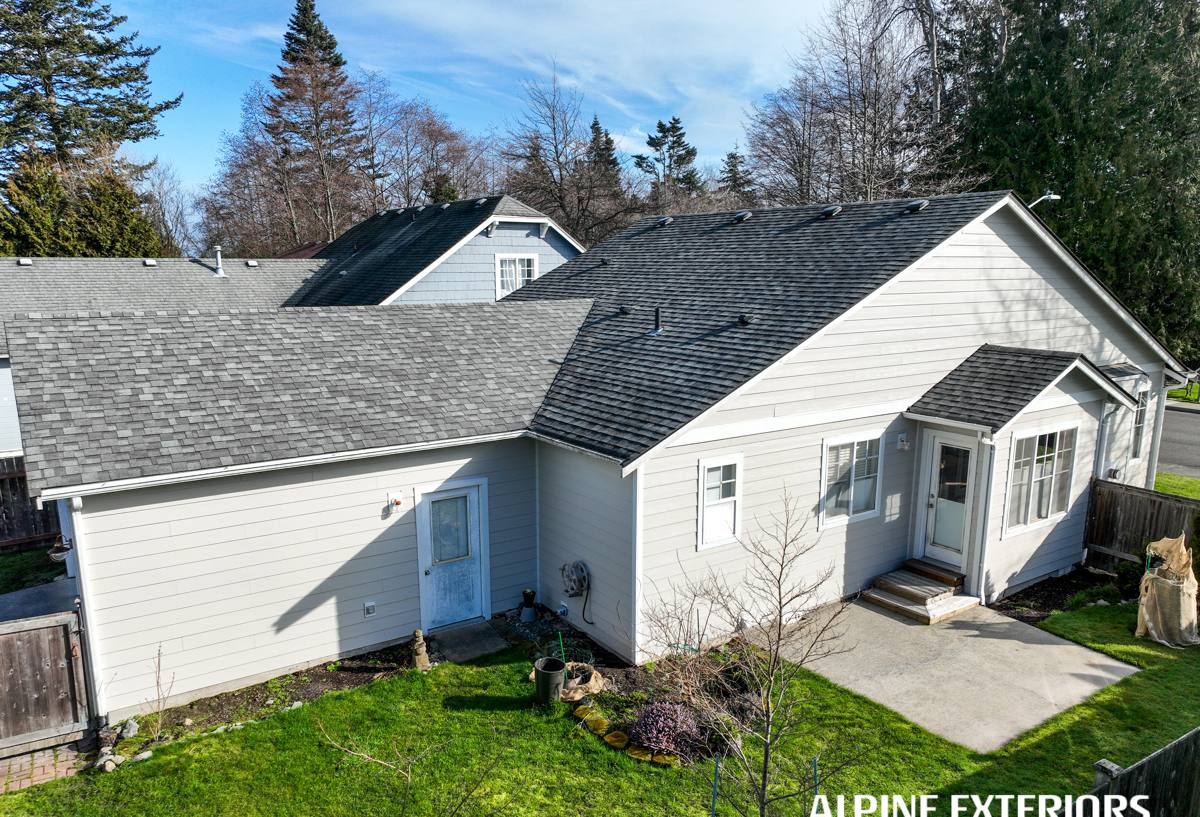
What the Climate Actually Does to a House
Moisture That Doesn't Let Up
Whatcom County doesn't get flash floods — it gets duration. Long stretches of steady, driving rain followed by damp overcast days mean exterior walls stay wet longer than they do in drier climates. Wood-based siding products absorb that moisture at cut edges, fastener holes, and seams. Once water gets behind the cladding, it doesn't dry out quickly under a canopy of Douglas fir and cedar — it just sits there, feeding rot and mold.
The Long Moss Season
Shaded, moisture-holding surfaces in this area grow moss for a good part of the year, not just in the depths of winter. Moss on a roof holds water against shingles and flashing far longer than bare material would. Moss and algae streaking on siding is mostly cosmetic, but it's a sign that a wall isn't drying between rain events — and that's the same condition that eventually causes real damage underneath.
Salt Air and Slow Corrosion
Air carrying salt content reaches into this part of the county and accelerates corrosion on anything metal that isn't properly rated for it — fasteners, flashing, hardware. Over years, that slowly undermines the parts of a siding or roofing system you can't see: the nails holding boards on, the flashing directing water away from windows and doors.
Why We Install Only James Hardie Siding
We get asked regularly why we don't offer vinyl, LP SmartSide, primed wood, or other fiber cement brands. It's not that those products don't have a place somewhere — it's that after years of working in exactly this climate, we don't think they hold up as well as James Hardie fiber cement does, and we'd rather stand behind one product we trust than offer a menu and let the trade-offs sort themselves out on a homeowner's dime.
Where Other Products Fall Short Here
- Vinyl siding expands and contracts with temperature swings, can crack in cold snaps, and doesn't stop moisture — it just directs it, which only works if every detail behind it is done right and stays right for decades.
- Engineered wood siding (like LP SmartSide) is a wood-based product at its core. It resists moisture better than raw lumber, but it's still vulnerable at cut edges and fastener points if caulking and paint maintenance lapse — and in a climate this wet, that maintenance window is unforgiving.
- Primed spruce and cedar are attractive and traditional, but they're the most maintenance-intensive option in a high-moisture, low-sun environment. Repainting and caulking cycles come faster here than they would in a drier region.
- Other fiber cement brands (Cemplank, Allura) compete on paper spec but don't carry the factory-applied ColorPlus finish, engineered climate-zone product lines, or the installer network and warranty structure we've come to rely on with Hardie.
What James Hardie Gets Right for This Area
James Hardie fiber cement is non-combustible, doesn't swell or rot from moisture the way wood-based products can, and holds its factory-baked ColorPlus finish far longer than field-applied paint. Hardie also engineers specific product lines (HZ5, HZ10) for different climate zones, which matters in a region that cycles between wet cold and humid summers. It's not a miracle product — it still has to be installed correctly, with the right clearances, flashing, and fastening — but it gives us a starting point that's built for weather like ours, backed by a strong transferable warranty.
Siding Material Comparison for This Climate
| Factor | James Hardie Fiber Cement | Vinyl | Engineered Wood | Primed Cedar/Spruce |
|---|---|---|---|---|
| Moisture resistance | High — won't rot or swell | Moderate — depends on drainage detail | Moderate — vulnerable at cut edges | Low — absorbs moisture readily |
| Fire resistance | Non-combustible | Melts/deforms | Combustible | Combustible |
| Finish longevity | Factory ColorPlus, long-lasting | Color molded in, can fade/chalk | Field-painted, needs upkeep | Field-painted, needs frequent upkeep |
| Maintenance cycle | Low — occasional wash, recaulk | Low but limited repair options | Moderate — paint/caulk every few years | High — frequent repaint/reseal |
| Typical lifespan | 30+ years to warranty limits | 20-30 years, brittle over time | 20-30 years with upkeep | 15-25 years with diligent upkeep |
Roofing, Windows, and Decks in the Same Climate
Siding doesn't work in isolation — it's one part of a building envelope that also includes the roof, windows, and any attached decks, and in this climate they all fail for related reasons: trapped moisture, poor drainage, and materials that weren't matched to the conditions.
Roofing
A roof under heavy tree cover deals with moss, needle buildup in valleys, and slow-draining debris more than it deals with wind damage. Proper ventilation and flashing at penetrations matter as much as the shingle or panel choice itself — a good roof with bad flashing details will leak, and a mediocre roof with excellent flashing will often outlast it.
Windows
Window flashing and sealant integration with the siding plane is one of the most common failure points we find on older homes in this area. Water doesn't usually come through the glass — it comes around the frame, down the wall cavity, and shows up as damage somewhere else entirely.
Decks
Exterior decks take the brunt of standing moisture, moss growth, and UV-starved shade in a wooded area like this. Ledger board flashing where a deck attaches to the house is a frequent trouble spot — the same driving rain that stresses siding walls stresses that connection point too.
What Correct Installation Actually Involves
The material is only half the equation. James Hardie siding installed without the right clearances, flashing, and fastening pattern can still fail — and a lot of the siding problems we get called out to inspect trace back to installation shortcuts, not the product itself.
- Proper weather-resistant barrier and flashing integration at every window, door, and penetration
- Correct ground and roofline clearances so siding doesn't sit in standing moisture or splashback
- Fastener spacing and type matched to Hardie's published installation specs, not generic guidelines
- Caulking and joint treatment at butt seams and trim intersections done to manufacturer standard
- Ventilation behind the cladding so the wall assembly can dry when it does get wet
A Seasonal Checklist for Homes in This Climate
Whether or not you're ready to replace siding, these habits go a long way in a climate like this:
- Walk the exterior each fall and spring looking for moss buildup, especially on shaded north and west walls and roof valleys
- Check gutters and downspouts before the heavy rain months — clogged drainage sends water straight down exterior walls
- Look at caulking around windows, doors, and trim for cracking or separation once a year
- Inspect deck ledger boards and any wall penetrations for staining or soft wood
- Have moss professionally treated rather than pressure-washed, which can drive water into seams
Why a Local Crew Matters
A contractor working across a wide swath of Washington sees a lot of different conditions and doesn't always tune their approach to any one of them. Working repeatedly in Whatcom County and communities like Sudden Valley means we see the same failure patterns often enough to know where they start — which flashing details matter most under a wet tree canopy, which walls take the worst of the driving rain, where moss actually causes damage versus where it's just cosmetic. That local repetition is what lets us make specific, honest recommendations instead of generic ones.
Get a Straightforward Estimate
If you're noticing moss buildup, soft spots, fading, or just want an honest read on how your siding, roof, windows, or deck are holding up against this climate, we're happy to take a look. There's no pressure and no obligation — just a clear assessment and, if replacement makes sense, straight answers about the James Hardie system and what installation would involve for your home. Use the form below to request a free estimate.