 Sudden Valley Siding
 Vinyl Siding: A Fair Look Before We Explain Our Position
Vinyl siding is the most widely installed exterior cladding in North America, and there are honest reasons for that. It's inexpensive relative to other siding types, it goes up fast, it never needs painting, and in dry inland climates with mild winters it can perform reasonably well for fifteen to twenty years. If you've priced out a siding job and vinyl came in thousands less than the alternatives, that's not your imagination — the material and labor costs really are lower.
We're not writing this page to tell you vinyl siding is junk. It isn't. It's a product engineered for a certain set of conditions and a certain price point, and it does what it's designed to do in a lot of the country. The problem is that Sudden Valley and the rest of Whatcom County aren't that environment, and after years of working on homes out here, we made a decision to stop installing it. This page explains the reasoning so you can make your own informed call.
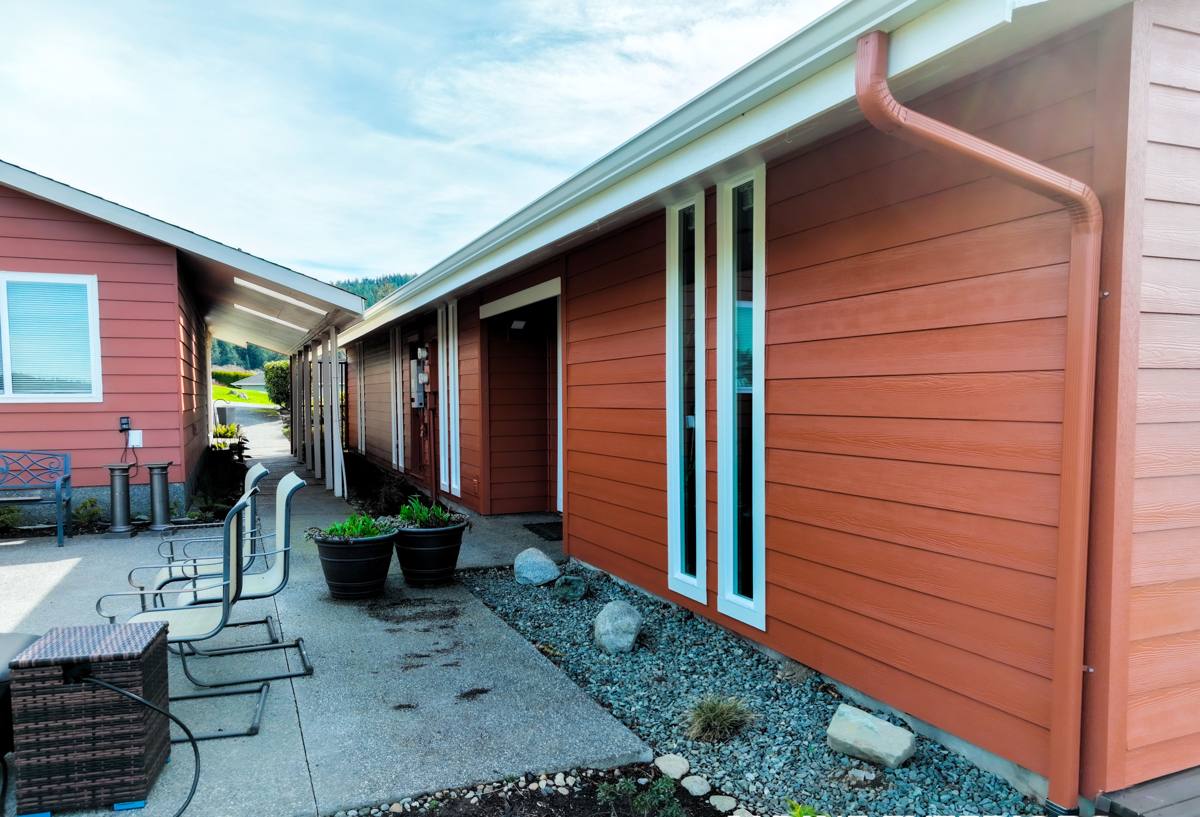
What Vinyl Siding Actually Is
Vinyl siding is extruded PVC (polyvinyl chloride) formed into overlapping panels, usually with a wood-grain or smooth texture stamped into the surface. Color is mixed into the plastic itself rather than applied as a coating, which is why manufacturers can honestly say it "won't need repainting." The panels hang on a wall by interlocking with each other and nailing loosely to the sheathing through slotted holes — loosely on purpose, because vinyl expands and contracts significantly with temperature and needs room to move without buckling.
That expansion behavior is the root of most of what follows. Vinyl is a thin, flexible plastic skin, not a rigid structural material, and it was never intended to be the water barrier for your house. It's a rain screen — it sheds the bulk of the water and lets some through by design, relying entirely on the house wrap and flashing underneath to do the real waterproofing work.
How It Gets Installed
Correct vinyl installation depends on a few things that are easy to get wrong on a real job site: nailing loosely enough to allow movement (over-driven nails are the single most common vinyl failure we see), leaving expansion gaps at every butt joint and corner, and getting the starter strip and J-channel level and true so the whole field of siding hangs correctly. None of this is exotic work, but it's fussy, and a crew paid by the square rather than by the hour has every incentive to nail it down tight and skip the gaps. You often can't tell the difference from the ground for the first year or two.
Why Marine Climate Conditions Change the Equation
Sudden Valley sits on Lake Whatcom, a short drive from Bellingham Bay, and the whole of Whatcom County lives under a Pacific marine climate: salt-laden air moving in off the Sound and the Strait of Georgia, long stretches of driving rain off the water, and short, low-sun winters that keep north-facing walls damp for weeks at a time. That combination is genuinely hard on siding, and it exposes vinyl's weak points faster than a drier or more sheltered region would.
Salt Air
Airborne salt doesn't corrode PVC the way it corrodes metal fasteners and flashing, but it does two things that matter. First, it accelerates UV-related fading and chalking on the vinyl surface, so color loss and that dusty, faded look tend to show up sooner on homes closer to the water. Second — and more relevant to the underlying wall assembly — salt-laden moisture works its way into every gap, seam, and fastener penetration in the siding field, which is exactly where vinyl's loose-panel design lets moisture through on purpose.
Driving Rain
Vinyl siding relies on gravity and overlap to shed water, which works fine in light or vertical rain. It works less well when wind drives rain sideways and upward under the laps, which is a regular event on exposed lots around Lake Whatcom and anywhere with a clear fetch off open water. Once water gets behind the panel, what happens next depends entirely on the quality of the house wrap, flashing, and drainage plane underneath — details that are invisible once the siding is up, and that vary enormously from one installation crew to the next.
Moss and Sustained Dampness
Whatcom County's moss season isn't a minor cosmetic issue — it's a sign of how long surfaces here stay wet. Shaded, north-facing, and tree-lined walls (common throughout Sudden Valley's forested lots) can stay damp for weeks at a stretch in fall and winter. Vinyl itself won't rot, but it also won't dry out the wood sheathing and framing behind it any faster just because it's plastic. If moisture gets trapped behind a vinyl wall — through a punctured seam, a poorly lapped J-channel, or wind-driven rain finding its way past the laps — it tends to stay trapped, because vinyl doesn't breathe or wick moisture the way some other claddings do, and problems develop unseen behind the panels for a long time before they show up as a soft spot or a smell inside.
The Failure Modes We See Locally
None of these are hypothetical scare stories — they're the ordinary, predictable ways vinyl siding ages in this climate over ten to twenty years:
- Warping and buckling from nails driven too tight, which becomes more visible after a few seasons of thermal cycling.
- Cracking at fastener points and corners in cold snaps, when PVC gets brittle and loses some flexibility.
- Fading and chalking on sun- and salt-exposed elevations, since color is baked into the plastic and can't be touched up or refreshed with paint the way other sidings can.
- Hidden moisture damage behind the panels, discovered only during a remodel, a window replacement, or when soft sheathing is found during an unrelated repair.
- Impact damage from hail, thrown debris in wind events, or even an errantly placed ladder — vinyl cracks and shatters rather than dents, and matching an older, faded panel color for a repair is often impossible.
Vinyl vs. James Hardie Fiber Cement: A Straight Comparison
| Factor | Vinyl Siding | James Hardie Fiber Cement |
|---|---|---|
| Material | Extruded PVC plastic | Cement, sand, and cellulose fiber |
| Moisture behavior | Non-absorbent skin; relies on gaps to shed, traps moisture if breached | Engineered HZ formulations for Pacific Northwest moisture cycling |
| Fire resistance | Combustible plastic; can melt or deform near heat sources | Non-combustible |
| Color/finish | Color mixed into plastic; fades and chalks over time, cannot be touch-repaired invisibly | Factory-applied ColorPlus finish backed by its own warranty |
| Impact resistance | Cracks and shatters under impact, especially in cold weather | Rigid, dent- and impact-resistant board |
| Typical lifespan (this climate) | 15-20 years before visible degradation | 30+ years with correct installation and maintenance |
| Warranty structure | Prorated, often voided by improper installation | Strong transferable, non-prorated manufacturer warranty |
| Repair/refinish options | Limited — repainting vinyl is not recommended by most manufacturers | Can be repainted decades later if desired |
Why We Standardized on James Hardie
We made a business decision years ago to install one exterior product system — James Hardie fiber cement — rather than offering vinyl, LP SmartSide, or other lower-cost alternatives as a menu option. Part of that is climate: Hardie's HZ5 product line is specifically formulated for the wet, temperature-swinging conditions of the Pacific Northwest, and fiber cement simply handles sustained moisture, salt air, and moss growth better than a plastic skin over a wood-framed wall. Part of it is fire resistance, which matters more every year in Washington. And part of it is warranty and accountability — when we install to Hardie's specification, the manufacturer's warranty is real and transferable, and we're not asking a homeowner to trust a product whose long-term performance in this exact climate is uncertain.
Standardizing on one system also means our crews install it constantly rather than occasionally. Fiber cement has its own installation discipline — proper fastener spacing, correct clearances at grade and roofline, sealed joints where Hardie specifies them — and that discipline only gets reliable with repetition. We'd rather be excellent at one product than mediocre across four.
What to Ask Before You Choose Vinyl Anyway
If cost is the deciding factor and you're still considering vinyl for a Whatcom County home, these are the questions worth pushing on with any contractor:
- What weight/thickness of vinyl (measured in mils) are you quoting, and is it rated for coastal or high-wind exposure?
- What house wrap and flashing details are going in behind the siding, and can you show me the manufacturer's installation instructions you're following?
- Is the fastening schedule nailed loose per manufacturer spec, or tight for a faster install?
- What does the manufacturer's warranty actually cover, and what voids it?
- How is this wall oriented — is it a shaded, north-facing, or tree-covered elevation likely to stay damp longer through moss season?
A Note on Cost Honesty
We won't pretend fiber cement costs the same as vinyl — it doesn't, and the material and labor are both more expensive up front. What we can tell you honestly is where that difference tends to even out: fewer replacement cycles over the life of the home, a warranty that holds up if something does go wrong, and a resale conversation where "James Hardie siding" reads as a maintained, quality home rather than a question mark. Whether that trade-off makes sense for your budget and your timeline is a real conversation, and we'd rather have it plainly than oversell either direction.
If you're weighing your options for a home in Sudden Valley or elsewhere in Whatcom County, we're happy to walk your property, look at your specific exposure to wind, rain, and shade, and give you a straight, no-pressure estimate for what Hardie fiber cement would actually cost on your house.