 Sudden Valley Siding
 Building a Deck That Actually Holds Up in Alger
Alger sits in the same wet, marine-influenced stretch of Whatcom County weather that shapes everything we build around Sudden Valley — salt-laden air off the nearby water, long stretches of driving rain, and a moss season that can run from fall clear through spring. A deck out here isn't just a weekend carpentry project. It's an outdoor structure that has to shed water fast, resist corrosion, and stay usable when the boards are wet nine months out of the year. Most of the deck problems we get called out to fix didn't start as bad workmanship — they started as decks built with materials and details suited to a drier climate than the one we actually have.
We build siding for a living, which means we spend more time than most contractors thinking about how water moves across an exterior wall. A deck that ties into a house is really an extension of that wall assembly. Get the connection wrong and you're not just risking a wobbly deck — you're risking rot behind the siding it's attached to.
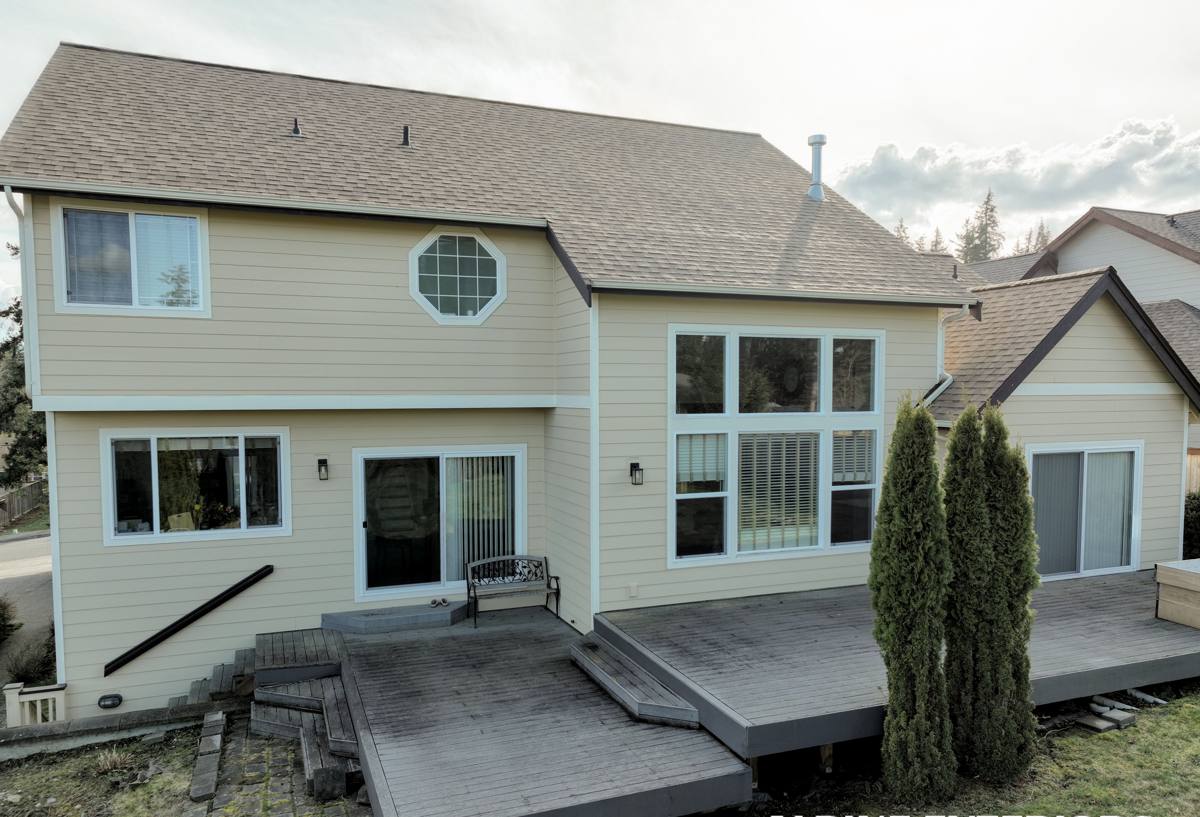
Where Decks Go Wrong on Homes Around Here
The Ledger Board Is the Weak Point
Nearly every attached deck failure we've diagnosed traces back to the same spot: where the ledger board bolts to the house. If that connection isn't flashed correctly — with the flashing tucked up behind the siding or house wrap and lapped properly over the ledger — water works its way behind the board a little at a time. In a climate with as much sustained rainfall as this one, "a little at a time" adds up fast. By the time you notice soft siding or a spongy spot on the rim joist, the damage is usually well established.
Fastener and Hardware Corrosion
Salt air doesn't just affect homes right on the water — it travels, and over years it will find any fastener that isn't rated for it. Standard galvanized screws and joist hangers can start rusting and staining within a few seasons out here. We spec stainless steel or heavy hot-dip galvanized hardware for structural connections, and we pay attention to fastener compatibility with whatever decking material is going down, since some coated deck screws react badly with certain treated lumber chemicals.
Moss, Algae, and Standing Water
Decking that doesn't drain and dry between boards becomes a moss farm. Tight board spacing, poor airflow underneath, and shaded, north-facing sites — common around wooded Alger lots — all extend how long a deck surface stays damp. That damp surface is exactly what moss and algae need to take hold, and once established they hold even more moisture against the wood, accelerating decay underneath the growth.
Choosing Materials for This Climate
There's no single "right" decking material for every homeowner — it comes down to how much maintenance you're willing to do versus what you want to pay up front. Here's how the common options actually perform in a wet, moss-prone marine climate:
| Material | Moisture & Rot Resistance | Moss/Algae Resistance | Maintenance | Relative Cost |
|---|---|---|---|---|
| Pressure-treated pine | Good if properly sealed and maintained | Fair — needs regular cleaning | Annual cleaning, periodic sealing | Low |
| Western red cedar | Very good naturally, better with finish | Fair to good | Cleaning and re-oiling every 1-2 years | Mid |
| Composite decking | Excellent — won't rot | Good, but surface algae can still grow and needs washing | Occasional washing, no sealing | Mid to High |
| PVC/capped composite | Excellent — fully moisture sealed | Very good | Low — periodic washing | High |
We install all of the above and won't push a homeowner toward the highest-margin option. Composite and capped-PVC boards make the most sense for shaded, low-airflow sites where wood would stay damp for days after a storm. Cedar and pressure-treated wood are honest, lower-cost choices if you're willing to keep up with cleaning and refinishing — the tradeoff is real maintenance time, not a defect in the material.
Framing, Footings, and Drainage
What's under the decking matters more than what's on top of it. Framing lumber should be rated for ground contact where it's within splash range, joists benefit from a protective tape over the top edge before decking goes down, and the whole structure needs a slight slope away from the house so water doesn't pool at the ledger. Footings need to be set to the correct frost and bearing depth for the soil on site — this isn't a place to guess, since an undersized or shallow footing is invisible until the deck starts to shift.
Spacing between boards, and airflow underneath the whole structure, are what actually control how fast a deck dries out after rain. A deck built low to the ground with no ventilation gaps will stay damp for days after a normal Whatcom County storm, even with premium decking on top.
Guardrails, Stairs, and Permits
Most elevated or attached decks require a building permit, and permit requirements typically kick in based on deck height and whether it's attached to the house. Guardrail height, baluster spacing, and stair rise-and-run all have to meet code, and inspectors do check these details. We handle the permit application and inspection scheduling as part of the job so homeowners aren't stuck learning the local process themselves — that paperwork is routine for us and it protects you if you ever sell the house.
How We Approach a Deck Project in Alger
- On-site assessment: we look at sun/shade exposure, existing drainage, soil conditions, and — critically — how the deck will tie into your siding and house wrap.
- Material walkthrough: we go over the honest tradeoffs between wood and composite options for your specific site, not a generic sales pitch.
- Permit and design: we handle the drawings and permit submission to the county so the structure, footings, and railings meet code from the start.
- Flashing-first construction: the ledger connection is flashed and integrated with your siding before framing continues — this is the step most decking-only crews rush.
- Framing and decking: proper joist spacing, ventilation gaps, and fastener selection matched to your material and our salt-air conditions.
- Final walkthrough: we check railings, stairs, and drainage with you before calling the job done, and pass inspection results along.
Why It Matters That We're Also a Siding Contractor
A deck built by a crew that doesn't think about wall assemblies can look fine for a year or two while quietly rotting the framing behind your siding at the ledger connection. We flash a deck ledger the same way we'd flash any other penetration through a wall — because that's exactly what it is. If your existing siding near the deck attachment point shows signs of past water damage, we'll flag it and address it as part of the deck build rather than fastening a new structure to a compromised wall.
This matters more in a climate that stays wet as long as ours does. A flashing mistake that might take five years to show up in a drier region can show up in two or three here, simply because the wood never gets a long enough dry stretch to recover between storms.
Keeping a New Deck Ahead of Moss Season
Even a well-built deck needs some seasonal attention. A few habits go a long way toward keeping moss and rot from getting a foothold:
- Sweep leaves and debris out of board gaps before they trap moisture
- Keep gutters and downspouts clear so roof runoff doesn't sheet directly onto the deck
- Scrub off moss and algae as soon as it appears, before it re-roots into the wood grain
- Re-oil or reseal wood decking on the schedule recommended for your specific product
- Check the ledger flashing and caulking line each fall for cracking or gaps
- Inspect visible fasteners and hardware for early rust staining
- Trim back overhanging branches to improve sun exposure and airflow where possible
- Confirm guardrail posts are still tight — wood movement from repeated wet/dry cycles can loosen connections over time
None of this is complicated, but skipping it is how a ten-year deck turns into a five-year deck in this climate.
Get an Estimate for Your Alger Deck Project
If you're planning a new deck or replacing one that's showing its age, we're happy to come take a look and walk you through what your site actually needs — no pressure, no generic quote pulled from a spreadsheet. Use the form below to request a free estimate.