 Sudden Valley Siding
 Yew Street and the Sudden Valley Climate
Homes along Yew Street sit inside one of Whatcom County's most heavily wooded residential communities. Sudden Valley's tree canopy, its position along Lake Whatcom, and its exposure to marine air moving in off the Salish Sea combine to create exterior conditions that are tougher on building materials than many homeowners expect. Salt-tinged air, long stretches of driving rain through fall and winter, and a moss season that can stretch from October well into spring all work on a home's siding, trim, and roofline year after year. None of this is unusual for the area — it's simply what exterior materials in this part of Whatcom County have to be built to handle.
We've worked on homes throughout Sudden Valley and the surrounding Bellingham-area communities long enough to know that a siding product that performs fine in a dry inland climate can fail early here. That's the lens we bring to every Yew Street estimate: not just what looks good on day one, but what still looks good and still protects the wall assembly after fifteen wet winters.
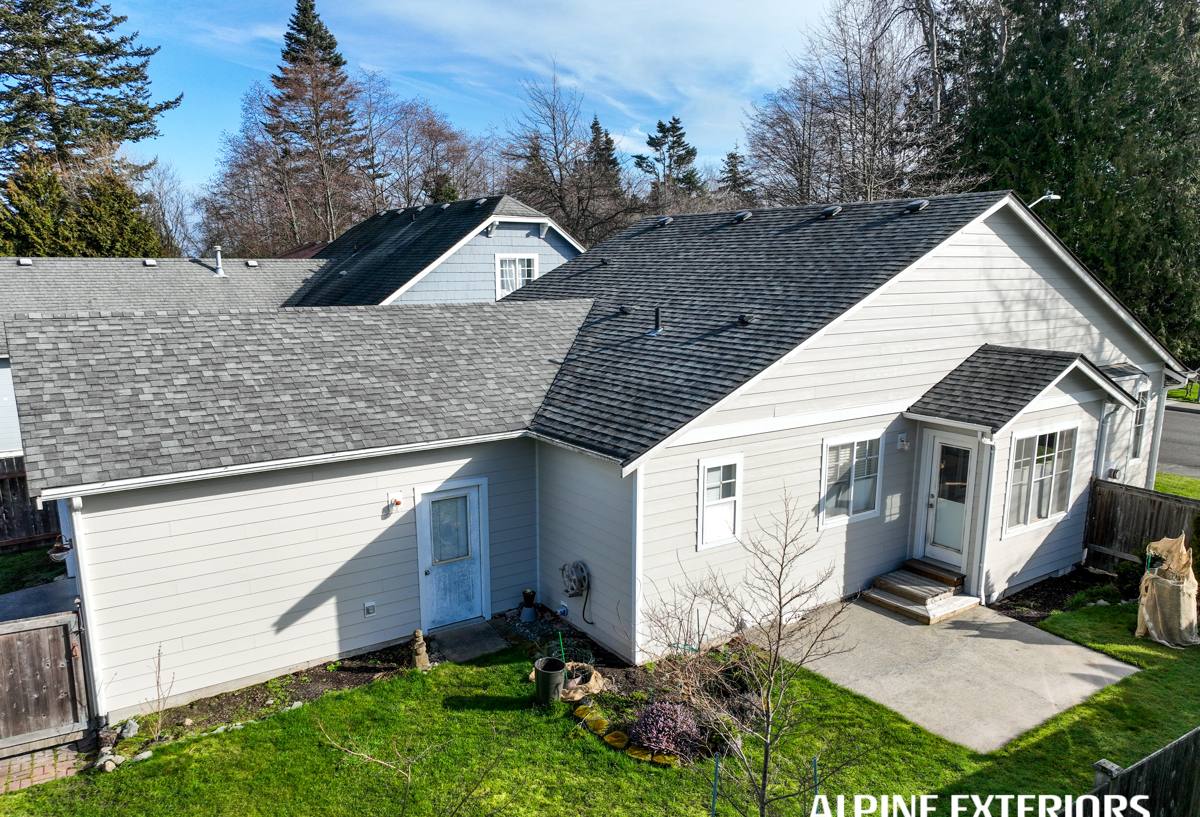
What Salt Air, Driving Rain, and Moss Actually Do to Siding
Moisture intrusion
Wind-driven rain doesn't just fall on a wall — it gets pushed sideways into laps, seams, and butt joints. Over time, any siding material with weak seams, poor flashing detail, or a tendency to absorb water at cut edges will start taking on moisture it can't shed. That moisture doesn't need to cause a leak to do damage; trapped water behind siding is enough to rot sheathing and framing long before a homeowner sees a visible problem.
Salt and airborne minerals
Marine-influenced air carries fine salt and mineral content that settles on exterior surfaces. On unprotected wood or thin factory coatings, this accelerates surface breakdown, fading, and corrosion of fasteners and trim hardware. It's a slow process, but it's constant, and it adds up faster on a home with heavy sun-and-shade cycling like the ones common along tree-lined streets in Sudden Valley.
Moss, algae, and shade
Dense tree cover means less direct sun to dry a wall out between storms. Shaded, north-facing walls in particular stay damp longer, which is exactly what moss and algae need to take hold. Once organic growth establishes itself on siding, it holds moisture against the surface even longer, and on materials that aren't dimensionally stable or moisture-resistant, that cycle accelerates deterioration underneath the growth, not just on top of it.
Why We Only Install James Hardie Fiber Cement
We get asked regularly why we don't offer vinyl, LP SmartSide, cedar, or other fiber cement brands. The honest answer is that we made a standard decision based on what holds up under exactly the conditions Yew Street sees every year, and we'd rather install one product correctly than offer five and have some of them fail early.
Where the alternatives fall short here
- Vinyl siding is affordable and low-maintenance, but it's a thin material that expands and contracts with temperature swings, can crack in impact or cold snaps, and its color is baked in rather than a separate finish — so fading over years of sun and salt exposure can't be touched up.
- LP SmartSide (engineered wood) performs reasonably when installed and maintained precisely to spec, but it's still a wood-based product at its core. In a climate with this much sustained moisture exposure, any lapse in caulking, flashing, or field-cut sealing creates an opening for water to reach the wood strand substrate, and repairs are harder to make invisible.
- Cedar and primed spruce siding are beautiful but demand ongoing upkeep — refinishing, caulking, and moisture monitoring — that most homeowners underestimate until the maintenance bill or the rot repair arrives.
- Cemplank and Allura are also fiber cement, and fiber cement as a category is the right call for this climate. We standardized on Hardie specifically for its factory finish system, product engineering for marine climates, and warranty structure, covered below.
None of this means those products are bad products in every application — it means we don't think they're the right long-term bet for homes taking the kind of weather Yew Street sees, and we'd rather turn down that work than install something we don't expect to still look good in fifteen years.
James Hardie: The Product System We Install
HZ5 climate engineering
James Hardie manufactures regional product formulations matched to climate zones, and the Pacific Northwest falls under the HZ5 engineering standard — built specifically to handle high-moisture, freeze-and-thaw conditions rather than a one-size-fits-all national product. That distinction matters more in Whatcom County than in a lot of the country.
ColorPlus factory finish
Rather than field-painted siding, ColorPlus finish is baked on in a controlled factory environment in multiple coats, which gives more consistent coverage and better fade and moisture resistance than a job-site paint job, and it comes backed by its own finish warranty separate from the substrate warranty.
Product lines we work with
- HardiePlank lap siding — the most common choice, available in several exposure widths and textures, used for the bulk of most home exteriors.
- HardiePanel vertical siding — often used for accent sections, gables, or a modern board-and-batten look.
- HardieShingle siding — a shingle profile for homes wanting that texture without the maintenance burden of real wood shakes.
- HardieTrim — matched trim boards for corners, window and door casing, and fascia, so the whole exterior envelope is a consistent, moisture-resistant system rather than mixed materials at the seams.
Because fiber cement is non-combustible, it also carries a wildfire-resistance benefit that some homeowners in wooded, tree-dense communities like Sudden Valley specifically ask about.
Material Comparison at a Glance
| Material | Moisture behavior | Maintenance | Finish durability | Typical lifespan |
|---|---|---|---|---|
| Vinyl | Doesn't absorb, but seams and gaps allow water behind it | Low | Color fades, can't repaint easily | 20-30 years |
| Cedar / primed spruce | Absorbs moisture; prone to rot without upkeep | High — regular refinishing | Requires repainting/staining | 15-25 years with upkeep |
| LP SmartSide | Engineered wood core; moisture-sensitive at cuts and seams | Moderate — sealing/caulk checks | Factory finish, moderate durability | 25-30 years |
| James Hardie fiber cement | Dimensionally stable, engineered for high-moisture climates (HZ5) | Low | ColorPlus factory finish, separate finish warranty | 30-50 years installed to spec |
These are general ranges, not guarantees — actual performance always depends on installation quality, exposure, and upkeep, which is why the next section matters as much as the material itself.
How We Install Siding on Sudden Valley Homes
Fiber cement is only as good as the installation behind it. A large share of the siding problems we get called out to inspect on older homes trace back to installation shortcuts, not the material itself.
Our process
- Exterior inspection — we check existing sheathing, framing, and any current moisture damage before quoting, especially around windows, decks, and roof-to-wall transitions, which are the most common failure points on tree-shaded homes.
- Weather-resistive barrier and flashing — proper house wrap and flashing at every penetration, window, and horizontal joint, installed to shed water down and out rather than trap it.
- Correct fastening and clearances — Hardie specifies fastener type, spacing, and minimum clearance from grade, decks, and roofing; skipping these is the single most common cause of early failure we see in the field.
- Factory-finished panels installed with matched, sealed trim — keeping the ColorPlus warranty intact means using Hardie's own trim and touch-up systems rather than mismatched materials.
- Final walkthrough — checking caulking, seams, and site cleanup before we consider the job done.
The Full Exterior Envelope: Roofing, Windows, and Decks
Siding doesn't work in isolation. Water that gets past a failing roof edge, an old window flashing detail, or a deck ledger board will show up as a siding problem even when the siding itself is fine. Because we also handle roofing, windows, and decks, we look at a Yew Street home's exterior as one connected system rather than quoting siding in a vacuum. That matters most at transition points — where a deck meets the house, where a roofline meets a wall, where old window trim has started to separate from the siding around it. Catching those during a siding project is far cheaper than finding them later as a hidden leak.
Signs Your Siding May Need Attention
- Persistent moss or algae growth that returns quickly after cleaning
- Soft or spongy spots when you press on the siding, especially near the bottom courses or window sills
- Visible cracking, warping, or separation at seams and corners
- Paint that's peeling or bubbling rather than just fading evenly
- Rising energy bills that suggest air and moisture are getting through the wall assembly
- Visible gaps around window and door trim
Why a Local Crew Matters
A crew that only occasionally works in Whatcom County can miss the details that matter here — how far siding needs to clear a deck ledger in a wet climate, which wall orientations need extra attention to moss and shade, how local permitting and inspection expectations work in this part of the county. We're on Sudden Valley streets and similar communities around Bellingham regularly enough to know what these homes actually face across a full year of weather, not just what a spec sheet says on paper.
If you're weighing a siding project on Yew Street — whether it's a full replacement, repair work after storm damage, or you're just trying to understand your options before committing to anything — we're happy to walk the exterior with you and give you a straight, no-pressure estimate using the form below.