 Sudden Valley Siding
 Siding in Ferndale: A Different Kind of Weather Test
Ferndale sits close enough to the water and the marine air pattern that moves through Whatcom County that homes here take a different kind of beating than homes twenty miles inland. It's not one dramatic storm that wears out a home's exterior — it's the steady combination of salt-tinged air, driving rain that comes in sideways more often than straight down, and a moss season that can run from fall through spring. Individually, none of these is extreme. Together, year after year, they're exactly the conditions that separate exterior materials that hold up from materials that don't.
When we look at a Ferndale home, we're not just evaluating the color or the current condition of the siding. We're thinking about how that specific product handles repeated wetting and drying cycles, whether moisture that gets behind the cladding has anywhere to go, and how the material will look and perform after a decade of the same weather pattern repeating itself. That's the lens behind every recommendation we make, and it's why we standardized on one siding system rather than offering several.
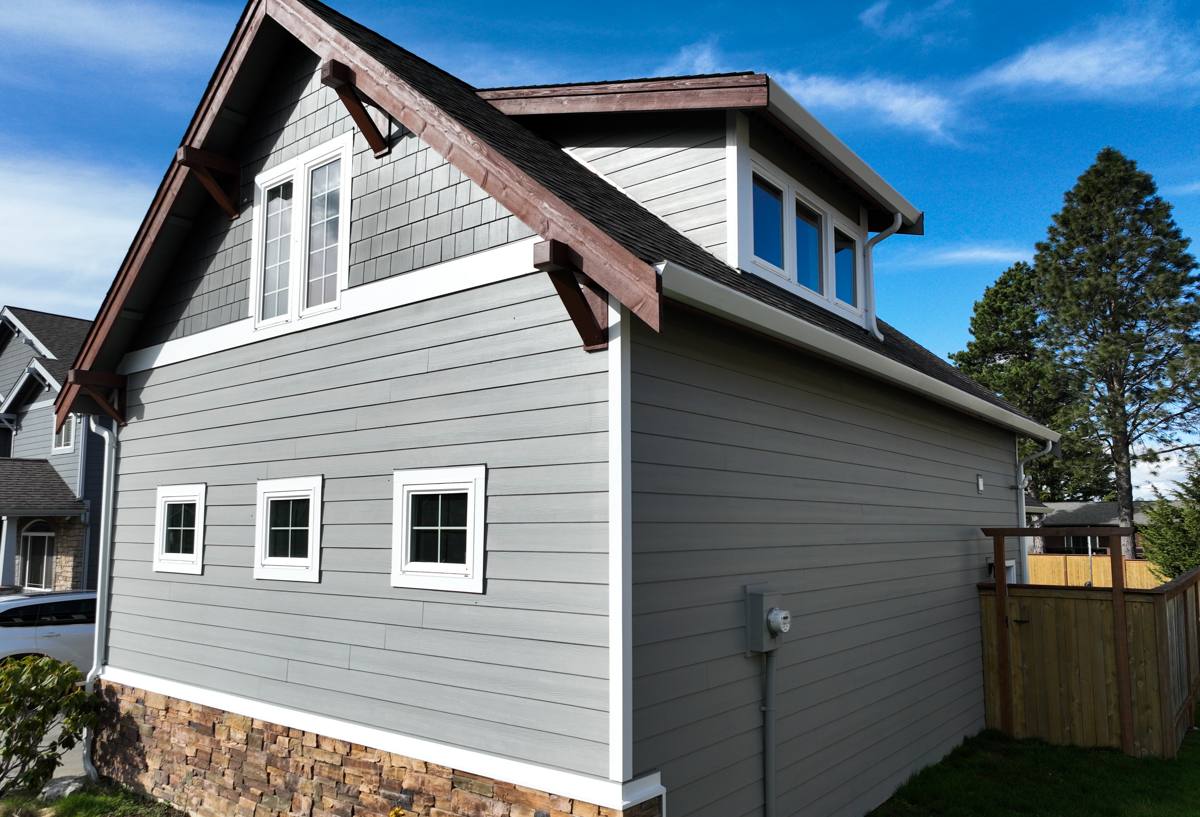
What Salt Air, Rain, and Moss Actually Do to a House
Salt Air
Homes closer to Bellingham Bay and the surrounding waterways deal with airborne salt that settles on exterior surfaces and accelerates corrosion of fasteners, flashing, and any exposed metal trim. It also interacts with certain coatings over time, which is part of why factory-applied, baked-on finishes tend to outperform field-applied paint in this environment.
Driving Rain
Whatcom County's storms frequently come with wind, which means rain doesn't just fall on a house — it's pushed into seams, laps, and trim joints. Siding systems and installation details that assume mostly vertical rainfall (common in drier climates) leave water pathways that this region exploits every winter.
Moss and Sustained Dampness
Moss doesn't just grow on roofs. It establishes in shaded, north-facing wall sections, behind gutters that overflow, and in any spot where siding stays damp longer than it should. Moss and algae growth hold moisture against the surface longer, which matters most for materials that absorb water rather than shed it.
None of this means a Ferndale home is doomed to constant repair. It means the exterior materials and installation details matter more here than they would in a milder, drier climate, and cutting corners on either one shows up faster than it would somewhere else.
Why We Install Only James Hardie Fiber Cement
We get asked regularly why we don't offer vinyl, LP SmartSide, or the lower-cost fiber cement alternatives like Cemplank or Allura. The honest answer is that we used to install a wider range of products, and the long-term callbacks and premature failures we saw in this specific climate — not in a lab, not in a sales brochure, but on actual Whatcom County homes — led us to standardize on one system.
What We Ruled Out, and Why
- Vinyl siding: Vinyl can crack in cold snaps, deforms in direct sun exposure over time, and its seams and J-channels give wind-driven rain more opportunities to find a path behind the cladding. It's also difficult to repair invisibly and offers limited resale upgrade value compared to fiber cement.
- LP SmartSide: An engineered wood product with a resin-treated strand board core. It performs reasonably well when installation and caulking are perfect and stay perfect, but any breach in that seal — a nail pop, a caulk failure, a gap at a butt joint — lets moisture into a wood-based core, and swelling or edge deterioration can follow. In a region with our rain volume, that margin for error is thinner than we're comfortable with.
- Primed spruce or cedar: Real wood siding can look excellent, but it demands a repainting and caulking maintenance schedule that most homeowners underestimate, and it's the most vulnerable of all common options to sustained damp conditions and rot.
- Cemplank and Allura: Both are legitimate fiber cement products and share Hardie's basic moisture resistance advantages. Our decision to standardize on Hardie specifically comes down to the factory ColorPlus finish process, the depth of Hardie's regional product engineering, and the strength and transferability of the warranty — not a claim that competing fiber cement is defective.
Fiber cement as a category resists moisture, doesn't rot, and is non-combustible — all real advantages in our climate. Within that category, James Hardie is the manufacturer whose finish system, product engineering, and warranty structure we trust enough to put our name behind.
The James Hardie System, Explained
James Hardie fiber cement is made from cement, sand, and cellulose fiber, cured into a dense, dimensionally stable board. It doesn't absorb water the way wood-based products do, it won't support combustion, and it holds paint and factory finishes far longer than wood or wood-composite siding because the substrate itself isn't expanding and contracting with every wet-dry cycle.
HZ5 Engineering for Our Climate
Hardie engineers its boards in region-specific formulations, labeled HZ3 through HZ10, matched to different climate zones across the country. Whatcom County falls in a zone where Hardie's HZ5 product line is the appropriate specification — engineered for cold, wet, and freeze-thaw conditions rather than the hot, dry formulations sold in the Southwest. Installing the correct zone-matched product is part of what makes the manufacturer's warranty valid, and it's a detail some out-of-area or lower-bid crews miss.
ColorPlus Factory Finish
Rather than field-painting siding after installation, Hardie's ColorPlus boards are finished in a controlled factory process with baked-on, UV-cured coatings applied in multiple coats. That finish resists fading, chipping, and the coating failures that show up first on field-painted wood or engineered wood siding exposed to salt air and constant moisture. It also means touch-up matching is more consistent than trying to color-match a weathered field-painted board years later.
Product Lines We Install
| Product | Typical Use | Notes |
|---|---|---|
| HardiePlank lap siding | Most common, full-home siding | Several exposure widths and textures available |
| HardiePanel vertical siding | Accent walls, board-and-batten look | Often paired with lap siding for contrast |
| HardieShingle siding | Gable accents, Craftsman-style detailing | Staggered or straight-edge patterns |
| HardieTrim boards | Corners, window and door trim, fascia | Matches or complements the field siding |
Installation Details That Matter Most in Whatcom County
Fiber cement is only as good as the installation behind it. In a driving-rain climate, the details most crews rush are the ones that determine whether water stays out for thirty years or finds its way in within five.
- Correct starter strip and flashing at the foundation line to keep splash-back and standing water away from the bottom course
- Properly lapped and sealed window and door flashing, integrated with a weather-resistant barrier behind the siding
- Manufacturer-specified fastener spacing and nailing patterns, sized correctly for HZ5 board thickness
- Butt joints backed and sealed rather than simply caulked at the face
- Adequate clearance between siding and grade, decking, and roof lines to reduce wicking and splash exposure
- Rainscreen or drainage gap detailing on wall sections with heavier wind-driven rain exposure
These aren't optional upgrades — they're what keeps a correctly chosen product performing the way it's designed to. A lot of the siding problems we get called out to inspect trace back to installation shortcuts on otherwise decent materials, not the material itself.
Beyond Siding: The Full Exterior Envelope
Siding doesn't work in isolation. We also handle roofing, windows, and decks because the exterior envelope of a Ferndale home has to work together as one system against the same weather.
Roofing
A roof shedding water improperly, or gutters that overflow onto wall sections, will undermine even correctly installed siding by keeping specific wall areas damp longer than the rest of the house — exactly the conditions that invite moss and accelerate wear.
Windows
Window flashing integration with the siding water-resistant barrier is one of the more common failure points we find during inspections. Replacing siding without addressing failing window flashing just moves the leak point rather than fixing it.
Decks
Decks attached to the home need proper ledger flashing where they meet the wall, since that's a high-exposure junction that sees both structural load and constant weather.
Looking at the whole envelope — not just the siding — is how problems that seem separate at first often turn out to share one root cause.
Cost Factors for a Ferndale Siding Project
Every home is different, but the variables that move a siding project's cost are consistent. We walk through these with homeowners during the estimate rather than quoting a number before seeing the house.
| Factor | Why It Matters |
|---|---|
| Home size and wall complexity | More corners, gables, and dormers mean more cutting, trim work, and labor time |
| Existing siding removal | Tear-off of old siding, and any sheathing repair found underneath, adds time before new material goes up |
| Moisture damage found during tear-off | Rotted sheathing or framing behind old siding has to be repaired before new siding is installed correctly |
| Product mix | Combining lap siding with shingle accents or vertical panel sections adds detail work |
| Trim and color scheme | Custom trim packages and multi-color ColorPlus schemes take more coordination than a single-color job |
| Access and site conditions | Slopes, tight lot lines, and staging space affect scaffolding and material handling |
Signs Your Siding May Be Due for Attention
Homeowners in Ferndale often live with early warning signs longer than they should, mostly because the damage isn't obvious from the ground. A few things worth checking:
- Soft or spongy spots when pressing on siding, especially near the bottom courses or under windows
- Persistent moss or algae staining that returns shortly after cleaning
- Visible gaps, warping, or separation at seams and corners
- Paint that's peeling, bubbling, or chalking heavily, particularly on wood or wood-composite siding
- Interior signs like musty smells or discoloration on walls that back up to exterior siding
- Fastener heads showing through the surface or streaking with rust
What Working With a Local Crew Looks Like
A crew that works Whatcom County regularly knows which wall exposures on a given street or subdivision take the worst of the wind-driven rain, which neighborhoods deal with heavier moss buildup, and how local permitting and inspection processes actually run. That local knowledge shapes real decisions — where we add extra flashing attention, which product textures and colors have held up well nearby, and how we sequence a project around our wet-season weather windows.
Our process on a typical Ferndale siding project starts with an on-site inspection and honest assessment of what's actually happening behind the existing siding, not just what's visible on the surface. From there we walk through product and color options, provide a detailed written estimate, and schedule the work around weather rather than rushing it into a rain window that compromises the installation.
If your siding is showing its age, if you're planning ahead for a roof, window, or deck project, or if you just want a straight answer about what your home's exterior actually needs, we're happy to take a look. Reach out for a free, no-pressure estimate — there's a form below to get started.