 Sudden Valley Siding
 Composite Decking in Sunnyland: What the Climate Actually Demands
Sunnyland sits close enough to the water that homes here deal with a specific mix of conditions: salt-tinged air drifting in off the bay, long stretches of driving rain through fall and winter, and a moss season that can run half the year if a surface stays shaded and damp. A deck built without that in mind will look fine for a season or two and then start showing problems that are expensive to fix after the fact. A deck built for it will still look good a decade later.
Composite decking is a strong fit for this environment when it's installed correctly, but "composite" isn't a single product with one set of rules. The board itself is only part of the equation. What sits underneath it, how it drains, and how it's fastened matter just as much as which brand of decking you pick.
Why Wood Struggles Here Faster Than Elsewhere
Whatcom County's damp, cool climate is hard on any deck, but it's particularly hard on wood. Cedar and pressure-treated lumber both need to dry out between rain events to stay sound, and in Sunnyland that drying window is short for much of the year. Add moss and algae growth on shaded or north-facing decks, and you get a surface that's not just aging cosmetically — it's holding moisture against the wood fibers and accelerating rot from the inside. Composite doesn't absorb water the way wood does, which removes that failure mode entirely, but it introduces its own set of installation details that have to be respected.
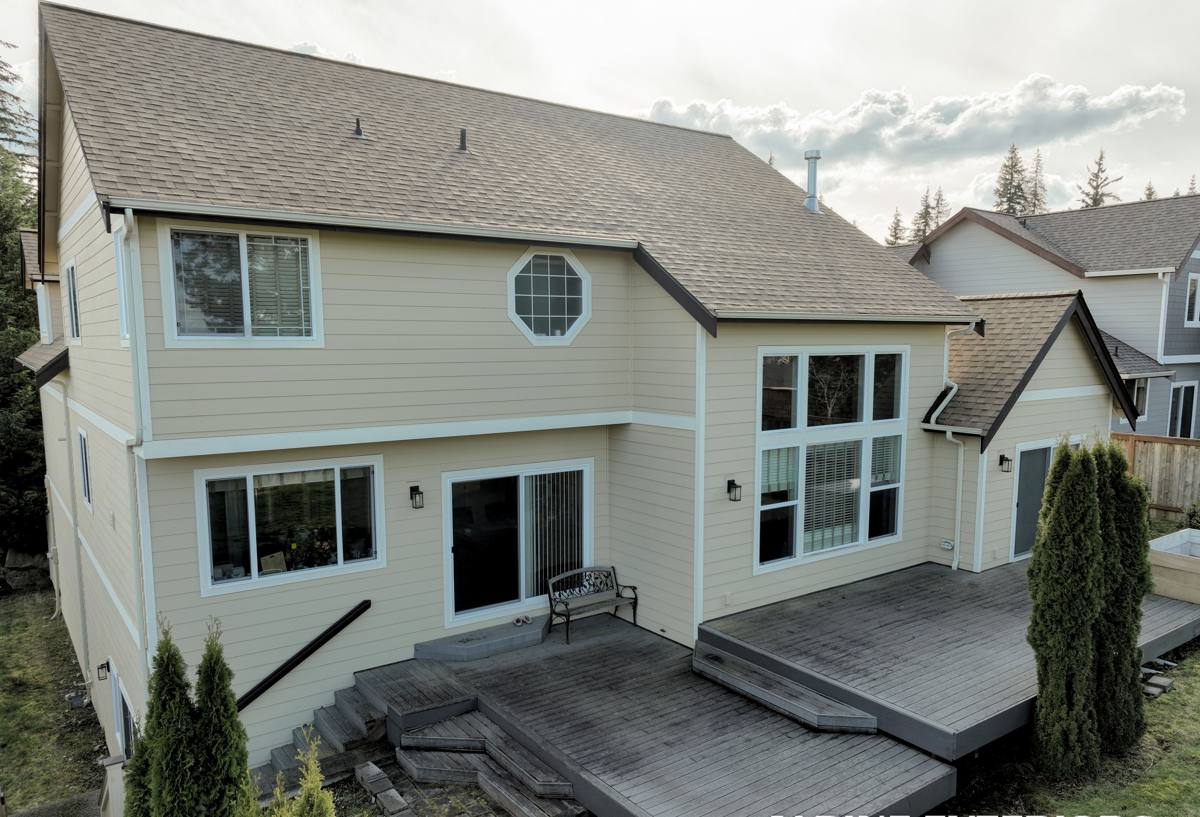
What a Correct Composite Deck Build Involves
The board is the part homeowners see and shop for, but the substructure underneath is what determines whether the deck performs for 20-plus years or starts having problems in five.
Framing and Drainage
Composite decking is heavier than wood, and it doesn't flex the same way, so joist spacing has to match the manufacturer's specification for the board profile you're using — not just whatever spacing was standard on the old deck. In a wet climate like ours, we also pay close attention to how water moves once it's under the deck: joist tape on the framing, proper slope away from the house, and gaps that let air move underneath rather than trapping moisture against the frame. A deck that drains well underneath is a deck that doesn't grow mold on the joists even if the surface board never absorbs a drop.
Hidden Fasteners and Board Spacing
Most composite systems use a hidden clip fastener rather than face screws, which gives a cleaner look and avoids the small water traps that form around screw heads. Board spacing has to account for both drainage and the material's expansion and contraction — composite moves with temperature more than people expect, and gaps that are too tight will buckle over a wet winter, while gaps that are too wide collect debris and moss spores.
Flashing at the House Connection
Where the deck ledger meets the house is the single most common point of water intrusion on any deck, composite or wood. Correct ledger flashing — installed so water sheds outward and never behind the siding — matters more in a climate with this much sustained rain than almost anywhere else in the state. This is also the point where deck work and siding work overlap, and it's one reason it pays to have a crew that understands both.
Composite vs. Other Decking Materials for This Climate
| Material | Moisture Behavior | Moss/Algae Resistance | Maintenance |
|---|---|---|---|
| Cedar | Absorbs and releases moisture; needs time to dry between rains | Prone to moss in shaded, damp spots without regular cleaning | Annual cleaning and re-sealing or staining |
| Pressure-Treated Pine | Absorbs moisture; can cup or warp if it can't dry out | Similar to cedar; rougher grain can hold moss spores | Regular cleaning, periodic sealing |
| Uncapped Composite | Resists rot but the exposed core can absorb some surface moisture over time | Better than wood, still needs periodic washing | Occasional cleaning; no staining or sealing |
| Capped Composite | Fully sealed shell; does not absorb water into the core | Best resistance; smooth cap sheds moss spores more easily | Occasional wash with soap and water |
We install capped composite as our standard recommendation in Sunnyland specifically because of that shell layer. In a climate with this much sustained moisture, the difference between a capped and uncapped board shows up over years, not months — but it shows up.
Our Process for a Sunnyland Composite Deck
- On-site assessment. We look at the existing structure (if there is one), grade and drainage around the house, sun exposure, and how the deck ties into the siding and roofline.
- Framing evaluation. If we're rebuilding on an existing frame, we check joist condition and spacing against current code and the decking manufacturer's specs — composite often requires tighter spacing than older wood decks were built to.
- Drainage and flashing plan. This gets decided before a single board goes down, including ledger flashing and any grading adjustments needed to keep water moving away from the foundation.
- Installation. Hidden fasteners, correct board gapping for our climate's temperature swings, and clean transitions at stairs, railings, and the house connection.
- Walkthrough. We go over basic care with you before we leave — what to expect in year one and what a normal maintenance routine looks like here.
Living with Moss Season: Maintenance That Actually Matters
Composite decking cuts out the sanding, staining, and sealing cycle that wood demands, but "low maintenance" doesn't mean "no maintenance," especially with the moss pressure Whatcom County puts on any outdoor surface.
- Sweep debris off the deck regularly, especially in fall — trapped leaves under standing water are the main driver of surface algae growth.
- Wash the deck surface with soap and water once or twice a year; a soft-bristle brush handles most buildup without damaging the cap.
- Keep gutters and downspouts near the deck clear so runoff isn't dumping directly onto the boards or the substructure underneath.
- Check that furniture and planters aren't sitting directly on the boards for months at a time without being moved — trapped moisture under an object is exactly where moss gets a foothold first.
- Look underneath the deck once a year if you can access it, checking that joist tape and flashing are still intact and that nothing is holding standing water against the frame.
What Drives Cost on a Composite Deck Here
| Factor | Why It Matters in Sunnyland |
|---|---|
| Board tier (uncapped vs. capped) | Capped boards cost more up front but hold up better against our moisture and moss exposure long-term |
| Substructure condition | Older frames often need joist replacement or re-spacing to meet composite manufacturer specs |
| Drainage and flashing work | Proper ledger flashing and under-deck drainage add labor but prevent the most common failure point |
| Railing system | Composite and metal railing systems vary widely in price and in how well they hold up to salt-tinged air |
| Deck size and layout | Stairs, multiple levels, and complex framing all add material and labor time |
Rather than quote a number without seeing the site, we walk the property and give you a real range based on what your specific deck needs — including whether the existing frame is salvageable or should be replaced.
Why a Crew That Already Works in Sunnyland Matters
Deck problems in this part of Whatcom County tend to follow a pattern: undersized drainage, ledger flashing that was never done right, or joist spacing that was fine for wood but wasn't rated for the composite board that got installed on top of it. A crew that works this area regularly has already seen those failures on other jobs and builds around them from the start, rather than learning the hard way on your deck.
It also matters for scheduling and follow-up. A local crew can walk a site, give you a straight answer about what your existing structure can and can't support, and come back easily if a warranty question comes up down the road. That's harder to get from a company that doesn't regularly work this side of the county.
Getting Started
If you're weighing composite decking for a home in Sunnyland, the most useful next step is having someone look at your actual site — the shade pattern, the drainage, the condition of what's there now — rather than pricing a project off a generic estimate. We offer a free, no-pressure estimate: we'll walk the property, talk through what your deck actually needs for this climate, and give you a straightforward range before you decide anything. The form below gets that started.