 Sudden Valley Siding
 Why Cordata Decks Wear Out Faster Than the Owner's Manual Says
If you own a home in the Cordata area, you already know the deck out back doesn't age the way the brochure promised. Bellingham-area weather is the reason. Whatcom County gets a long stretch of low-intensity rain from fall through spring, humid air off the Salish Sea and Lake Whatcom, and shaded yards from mature fir and cedar that keep moisture sitting on wood and composite surfaces far longer than in drier parts of the state. Add in the moss and algae that thrive in that same shade, and a deck here is under near-constant low-grade attack even when nothing looks obviously wrong.
Most decks don't fail because of one big storm. They fail slowly — a ledger board that's been wicking moisture for three winters, joist hangers rusting quietly under a deck board that still looks fine on top, or a surface that's gone slick with algae long before anyone calls it "rotten." By the time a board cracks under someone's foot, the damage underneath is usually years old.
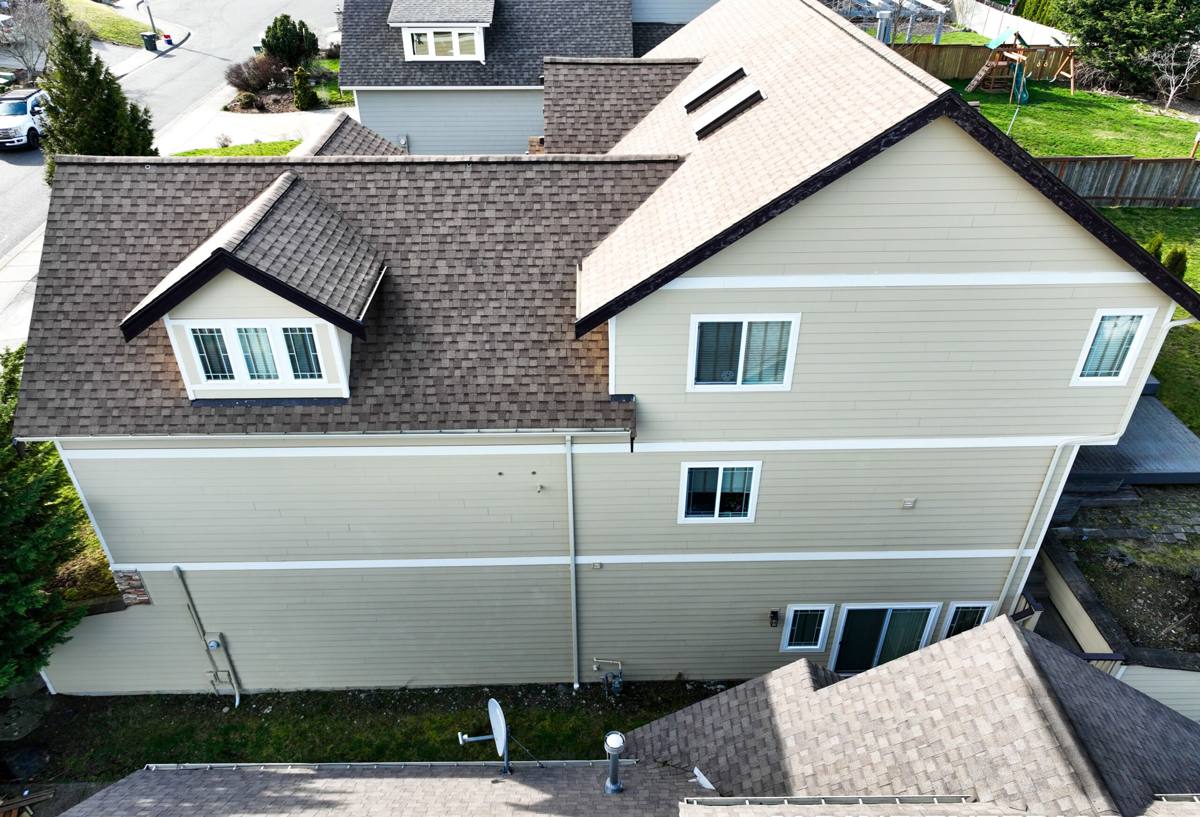
What Cordata's Climate Actually Does to a Deck
Moss and Algae
Shaded lots and consistent damp mean moss and algae aren't a cosmetic nuisance here — they're a structural issue. Both hold water against wood and composite surfaces, and moss in particular works into seams, fastener holes, and board gaps, keeping those spots wet long after the rest of the deck has dried. Over a few seasons that constant dampness is what starts real rot, not any single storm.
Driving Rain and Wind-Driven Moisture
Rain in this area doesn't fall straight down — wind off the water pushes it sideways under railings, into ledger connections, and along the house band board where the deck attaches. That's the single most common failure point we find: the ledger connection, where the deck meets the house, is exposed to more moisture cycling than almost any other part of the structure.
Freeze-Thaw and Temperature Swings
Whatcom County doesn't get brutal winters, but it does get repeated freeze-thaw cycling — nights near freezing, days above it, water in the wood expanding and contracting. On older or already-compromised wood, that cycling accelerates cracking and fastener loosening.
Signs a Cordata Deck Needs Replacement, Not Just Repair
- Soft, spongy, or springy spots when you walk the deck, especially near the house or stairs
- Persistent moss or dark staining that comes back within weeks of cleaning
- Visible gaps, cracking, or splintering across multiple boards rather than one or two
- Rust streaking around fasteners or joist hangers
- Railings that flex or wiggle more than they used to
- A ledger board or rim joist that feels damp or discolored to the touch
- A deck older than 15-20 years that's never had the substructure inspected
A few soft boards can sometimes be spot-repaired. Widespread softness, a compromised ledger, or rot that's reached the framing means repair is just delaying the real cost — and often masking it, since new boards over bad framing still fail from underneath.
What a Correct Deck Replacement Actually Involves
A deck replacement done right in this climate isn't just pulling old boards and screwing down new ones. The parts nobody sees are what determine whether the new deck lasts 10 years or 25.
1. Full Structural Assessment
Before anything gets torn out, we check the ledger connection, joists, posts, and footings. In a lot of Whatcom County homes, the ledger flashing was never installed correctly to begin with, which is often the real reason a deck failed in the first place — replacing the decking without fixing that just resets the clock on the same problem.
2. Proper Ledger Flashing
This is the single most important detail on a deck attached to a house in a wet climate. Correct flashing — installed in the right order relative to the house's weather-resistive barrier — keeps water from tracking behind the siding and into the wall framing. This is exactly the kind of detail that gets rushed on a fast rebuild and causes hidden damage years later.
3. Framing and Fastener Upgrades
We use corrosion-resistant hardware rated for coastal and high-moisture exposure — not generic interior-grade fasteners. Joist hangers, structural screws, and post bases all matter more here than in a dry climate, because ordinary galvanized hardware corrodes faster under constant damp and salt-tinged air.
4. Drainage and Airflow
Decks that trap moisture underneath rot from below even when the top looks fine. Correct joist spacing, ventilation gaps, and grading beneath the deck let air move and water drain instead of pooling against the framing.
5. Decking Material Selection
The right material depends on budget, maintenance appetite, and how much shade and moss exposure the specific spot in the yard gets.
Decking Material Comparison for Whatcom County Conditions
| Material | Moss/Moisture Resistance | Maintenance | Typical Lifespan Here |
|---|---|---|---|
| Pressure-treated wood | Moderate — needs sealing to perform | Annual cleaning, periodic sealing | 10-15 years |
| Cedar | Good natural resistance, still needs care in shade | Cleaning and refinishing every 1-2 years | 12-18 years |
| Composite (capped) | Very good — resists moisture absorption | Periodic washing to prevent surface moss/algae | 20-30 years |
| PVC | Excellent — non-organic, doesn't absorb moisture | Occasional washing | 25-30+ years |
Composite and PVC cost more upfront, but in a shaded, damp Cordata yard the maintenance savings and moisture resistance often make them the more honest long-term choice. Cedar and pressure-treated wood are still solid options, especially on sunnier lots — they just require an owner willing to keep up with cleaning and sealing on a real schedule, not "when I get around to it."
Our Deck Replacement Process
- On-site assessment — we check decking, framing, ledger connection, footings, and drainage before quoting anything
- Honest scope discussion — what's structural, what's cosmetic, and what your options actually cost
- Demolition and disposal — old decking and any compromised framing removed
- Structural repair — ledger reflashing, joist and post replacement as needed, corrosion-resistant hardware throughout
- Decking installation — material installed per manufacturer spec, with proper spacing for drainage and seasonal movement
- Railings and stairs — brought up to current code, not just matched to what was there
- Final walkthrough — we show you what was done and why, including anything underneath you wouldn't otherwise see
Why a Crew That Already Works Cordata Matters
Deck framing and flashing details that work fine in Eastern Washington or drier parts of the country don't hold up the same way here. A crew that works Cordata and the surrounding Sudden Valley and Whatcom County area regularly already knows which ledger details fail first in this climate, which decking materials actually shed moss instead of feeding it, and how much drainage a deck really needs under our rain pattern — not the generic national spec.
That local pattern recognition is what separates a deck that needs attention again in five years from one that doesn't. It also means we're not guessing at permit requirements or inspection expectations for the county — we've been through them before, on homes near yours.
Cost Factors to Expect
| Factor | Why It Matters |
|---|---|
| Deck size and shape | More linear footage, more framing, more cost |
| Substructure condition | Rotten joists, posts, or footings add cost but aren't optional to fix |
| Ledger/flashing repair | Often the most important — and most overlooked — line item |
| Decking material | Wood costs less upfront; composite/PVC cost more but need less upkeep |
| Railings and stairs | Code-compliant railings and stair stringers add material and labor |
| Height and access | Multi-level or elevated decks require more structural work |
We won't quote a deck sight unseen, and we won't hand you a number that hides the framing repair in fine print. What you're quoted is what covers the whole job — decking, structure, and hardware.
Maintaining Your New Deck Through Whatcom County Winters
- Sweep debris and standing leaves off the deck regularly through fall — trapped leaves hold moisture and feed moss
- Clean moss and algae off the surface at the first sign of it, before it spreads into seams
- Check that gaps between boards stay clear so water keeps draining rather than pooling
- Inspect railings and stair connections once a year for any looseness
- If you have wood or cedar decking, keep to a real sealing schedule rather than skipping a year
- Keep an eye on the area where the deck meets the house — that's still the spot most worth checking
If your deck in Cordata is showing soft spots, persistent moss, or you just want an honest read on whether it needs repair or replacement, we're glad to take a look. Fill out the form below for a free, no-pressure estimate.