 Sudden Valley Siding
 What Edgemoor's Weather Actually Does to Siding
Homes around Edgemoor and Sudden Valley sit close enough to open water and heavy tree cover that siding here takes a different kind of beating than siding fifty miles inland. Whatcom County's marine climate means three things show up on exterior walls faster than most homeowners expect: salt-laden air off the water, wind-driven rain that hits siding sideways instead of straight down, and long stretches of shade that keep moisture sitting on the wall long after a storm passes. A siding material and installation that don't account for all three will start showing problems within a handful of years, not decades.
Salt Air and Corrosion
Proximity to salt water doesn't just affect metal — it accelerates the breakdown of paint films and raw wood siding faster than the same product would fail inland. It's also why fastener and trim choice matters more here than in a lot of Whatcom County: stainless or hot-dip galvanized hardware belongs on any job this close to the water, and a siding product that depends entirely on a surface-applied paint job for its weather resistance is going to need attention sooner in this air than it would elsewhere.
Driving Rain
Storms off the water regularly push rain sideways into walls rather than letting it run straight down and off. That matters because a wall assembly's real job isn't to keep water from ever touching the siding — it's to manage the water that does get behind it and get it back out. Siding and flashing details that only work for water falling straight down tend to fail first at seams, butt joints, and window trim, usually on whichever elevation faces the weather.
Moss and Shade
Between Sudden Valley's tree cover and Edgemoor's mix of mature landscaping, shaded and north-facing walls stay damp for days after a storm while sun-exposed elevations dry out in hours. That's exactly where moss and algae get a foothold, and once a growth layer establishes itself, it holds moisture against the siding surface continuously — not just during rain — which is a very different and more constant stress than the rain event itself.
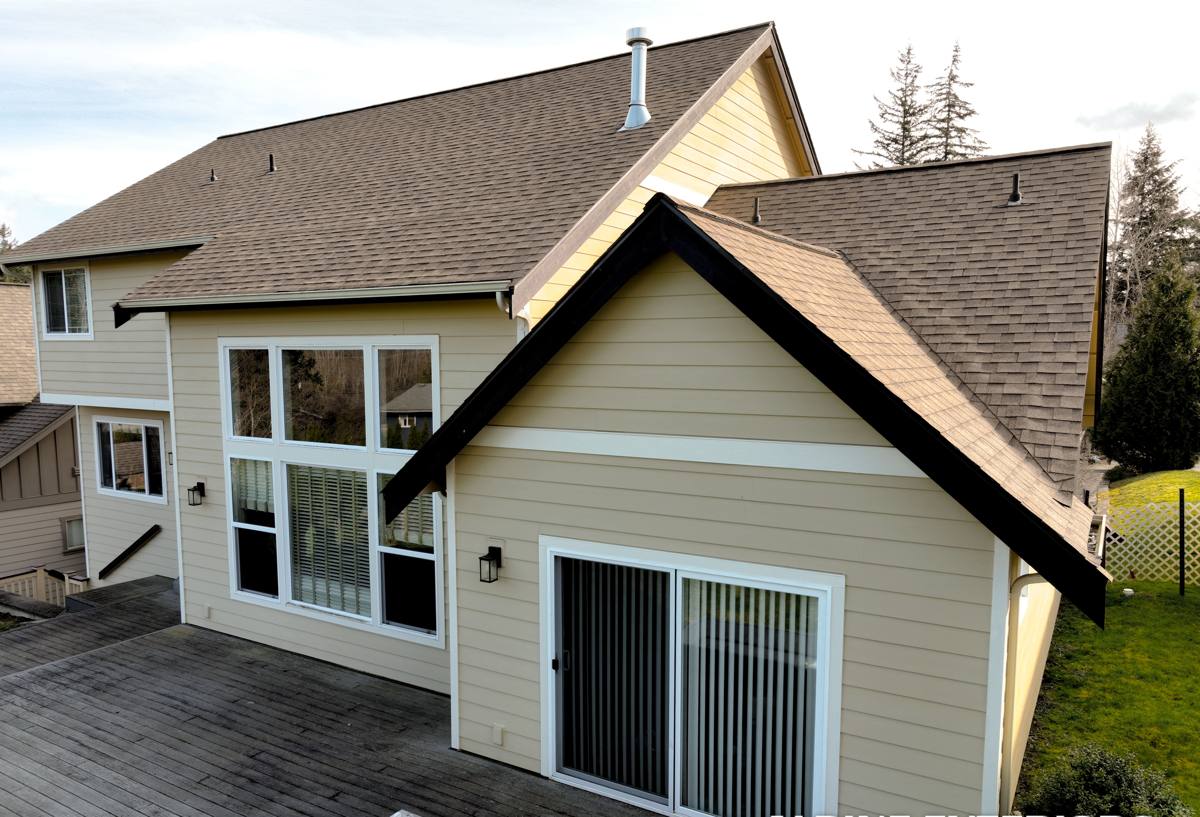
Why James Hardie Fiber Cement Fits This Climate
We install James Hardie exclusively, and in an environment like this one, the reasoning isn't abstract. Fiber cement is dimensionally stable in a way wood-based products aren't — it doesn't swell, cup, or absorb moisture the way engineered wood siding can, which matters directly on walls that spend half the year damp.
Engineered for the Moisture Cycle
James Hardie's HardieZone system is built around matching the product to real climate conditions rather than shipping one formulation everywhere. In wet, marine-influenced regions like ours, that means a product engineered to resist moisture-related damage through repeated wet-dry cycles — which is the exact cycle this area puts siding through most of the year, not an occasional edge case.
ColorPlus Finish vs. Field-Painted Siding
Most of what fails first on painted siding near the water is the paint, not the substrate underneath it. James Hardie's ColorPlus finish is baked on at the factory in multiple coats under controlled conditions, which holds up to UV and moisture exposure meaningfully longer than a field-applied paint job, and it comes with its own finish warranty. That matters here specifically: less repainting means fewer chances for water to find its way behind a compromised paint film during the wet months.
Non-Combustible
Fiber cement doesn't burn, which isn't the primary concern on a waterfront lot the way it is further inland, but it's still a real, permanent advantage over wood-based and vinyl products — one less long-term risk on a material you're putting on the house for good.
What a Correct Fiber Cement Installation Actually Involves
Fiber cement siding is only as good as the wall assembly behind it. A lot of the siding problems we get called out to inspect on older homes aren't material failures — they're installation shortcuts that let water get behind the cladding with nowhere to go.
Drainage Plane and Rain Screen Gap
Correct installation starts with a continuous water-resistive barrier and, on a house taking this much wind-driven rain, a rain screen gap that lets any moisture that does get behind the siding drain and dry out instead of sitting against the sheathing. Skipping this step is one of the most common corners cut in fiber cement installs, and it's invisible once the siding is up — which is exactly why it matters who's installing it.
Fastening and Clearances
James Hardie publishes specific fastener spacing, penetration depth, and clearance requirements — including minimum gaps between the siding and grade, roofing, decks, and other trim — and those specs exist because getting them wrong is what voids warranty coverage and lets water in. In salt air, fastener material matters too: corrosion-resistant fasteners aren't optional here.
Flashing and Trim Details
Windows, doors, and any horizontal trim are where siding jobs actually succeed or fail over time. Proper head flashing, kick-out flashing at roof-to-wall intersections, and correctly lapped house wrap at every penetration are what keep driving rain from finding its way behind the cladding at the exact spots where it's most likely to try.
Fiber Cement vs. the Alternatives, in This Climate
Homeowners in Edgemoor and Sudden Valley often ask what they'd be giving up — or gaining — with a different material. Here's an honest comparison based on how each product actually performs in a wet, salt-influenced, shaded environment like this one.
| Material | Moisture Behavior Here | Maintenance in This Climate | Typical Lifespan |
|---|---|---|---|
| Vinyl siding | Doesn't absorb water, but seams and panels can warp or gap over time, giving wind-driven rain a path behind the wall | Low, but cracks and fades; hard to patch invisibly | 20-30 years, shorter with UV and impact damage |
| Cedar / primed wood | Absorbs moisture readily; shaded, mossy walls stay damp longest and are most prone to rot | High — repainting or restaining every few years, more often in shade | Highly variable; often 15-25 years before major repair |
| LP SmartSide (engineered wood) | Better than raw wood but still wood-based; edge and cut-end sealing is critical and easy to miss | Moderate; touch-up painting and edge inspection needed | Manufacturer-rated but installation-sensitive |
| James Hardie fiber cement | Dimensionally stable, doesn't swell or rot; engineered for wet climate zones | Low — occasional wash, factory finish reduces repainting | Long service life with a strong transferable warranty when installed to spec |
The honest caveat with any of these materials, Hardie included, is that installation quality matters as much as the product itself. A poorly installed fiber cement job can still trap moisture; a well-installed alternative can outperform a badly installed one. That said, we've made fiber cement our standard because it gives a well-installed wall the widest margin for error against this specific climate.
How We Approach a Siding Job in Edgemoor and Sudden Valley
Every job starts with a walk-around of the whole exterior, not just the visibly damaged sections, because the elevations that look fine from the ground are often hiding the earliest moisture damage behind trim and at butt joints.
- Full exterior assessment, including moisture readings at trim, corners, and any areas with visible staining or moss buildup
- Removal of old siding and inspection of the sheathing underneath for hidden rot before anything new goes up
- Repair or replacement of any damaged sheathing — this gets flagged and discussed before we cover it back up
- Installation of a continuous water-resistive barrier and rain screen gap
- James Hardie fiber cement installed to manufacturer fastening, clearance, and flashing specifications
- Corrosion-resistant fasteners and trim hardware on every job this close to the water
- Final walk-through covering finish, caulking, and clearances before we consider the job done
Why It Matters That We Already Work This Area
A crew that's put siding on homes throughout Sudden Valley and the surrounding Whatcom County waterfront knows which elevations on a given lot are going to take the worst of the driving rain before the first panel goes up, and which shaded walls need extra attention to moss and drainage. That's not something you get from a general contractor doing their first job in the area.
Local knowledge also matters for the practical side of the project. If your property falls within a homeowners' association, exterior changes like siding replacement often need approval before work starts, and knowing that ahead of time avoids delays mid-project. A crew that regularly works this specific area also has a realistic sense of scheduling around the wetter months, since fiber cement installation goes faster and cleaner in a dry weather window than it does mid-storm-season.
Maintenance: What Actually Keeps This Siding Performing Here
James Hardie siding is low-maintenance, not no-maintenance, and the maintenance that matters most in this climate is different from what a drier region would need.
What to Watch For
- Moss or algae buildup on shaded, north-facing walls — a soft wash removes it before it holds moisture against the siding long-term
- Caulking at trim, window, and door joints — this is the first place wind-driven rain finds a way in if it fails
- Fastener and trim corrosion near the water — worth a visual check every year or two
- Standing debris or plant growth against the base of the siding, which traps moisture at grade
None of this is difficult work, but it's the kind of thing that's easy to let slide for a few years — and a few years is long enough for a small maintenance issue to become a bigger repair on a house that sits this close to the water.
If you're weighing a siding replacement or repair on a home in Edgemoor or anywhere around Sudden Valley, we're glad to walk the exterior with you and give you a straight, no-pressure assessment of what your walls actually need. Use the form below to request a free estimate.