 Sudden Valley Siding
 Board & Batten in a Lake Whatcom Climate: Why Geneva Homeowners Choose It
Board and batten is one of the most requested siding styles in the Geneva area, and it's easy to see why. The bold vertical lines and deep shadow gaps from the battens give a home real texture — it reads as more custom than flat lap siding, whether it's covering a whole exterior or dressing up a gable, entry, or accent wall over a mix of siding styles. It pairs naturally with the craftsman and modern farmhouse looks that are common on homes around Sudden Valley and the wider Lake Whatcom basin.
The catch is that board and batten has always been harder to keep watertight than plain lap siding. Every batten creates a seam, and every seam is a place water can find its way in if the installation isn't done with real attention to detail. In a climate like Whatcom County's — long wet stretches, humid marine air moving in off Puget Sound, and tree cover that keeps walls shaded and slow to dry — those seams get tested far more often than they would in a drier part of the country. That's the entire reason this page exists: board and batten done right here looks great for decades, and board and batten done as an afterthought fails early, specifically at the battens.
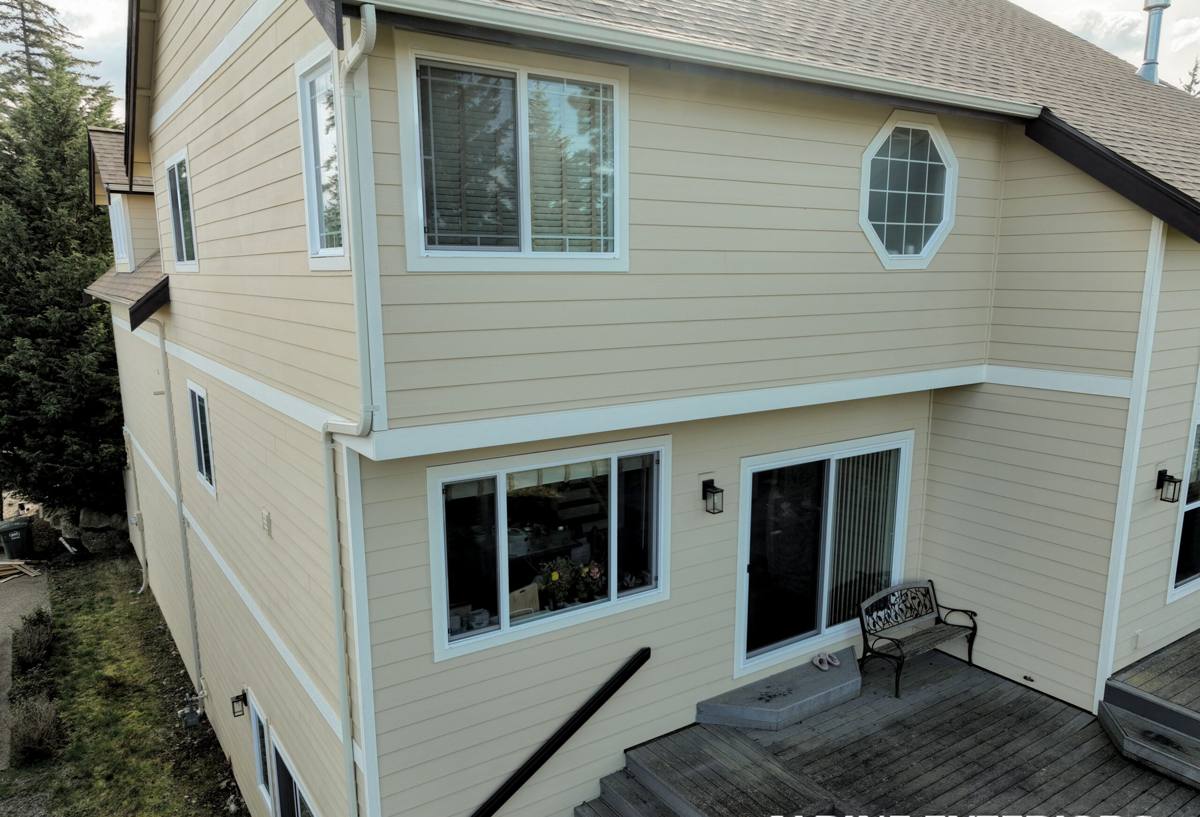
What the Geneva Climate Does to Vertical Siding Over Time
Homes in and around Geneva sit in a wet, heavily wooded pocket of Whatcom County. That combination of rainfall, humidity, and shade is exactly what board and batten siding needs to be engineered against.
Moss and algae on shaded elevations
Lots near Lake Whatcom tend to have mature conifer cover, and north- and east-facing walls that stay shaded for most of the day. Add a long wet season on top of that and you get slow-drying wall surfaces — the exact conditions moss and algae need to take hold. On wood board and batten, that moisture sits against the battens and behind them, which is where rot starts. On a properly installed fiber cement system, moss can still grow on the surface, but it isn't feeding into the substrate underneath.
Where board and batten fails first
When board and batten siding fails, it almost never fails in the middle of a flat panel. It fails at the seams under the battens, at cut ends that were never sealed, at the bottom edge near grade, and at fastener heads that were driven wrong and left an open path for water. A correct installation treats every one of those points as a detail to get right, not an afterthought.
What a Correct Board & Batten Installation Actually Involves
Board and batten is a system, not just a look. Getting the appearance right is the easy part — getting the water management right underneath it is what separates a siding job that lasts from one that needs attention again in five to seven years.
- A continuous weather-resistive barrier installed and lapped correctly behind the panels, with all penetrations sealed
- Correct panel gapping so the material can expand and contract without buckling or opening seams
- Battens fastened with the manufacturer's specified nailing pattern and spacing — not just wherever they line up visually
- Flashing at every window and door head, and kickout flashing where a roofline meets a wall
- Proper clearance between the bottom of the siding and grade, decks, patios, and roof surfaces
- All cut edges sealed before installation, since a raw cut edge is the most vulnerable point on any panel
- Caulking used at the joints the manufacturer specifies — and skipped where it isn't, since over-caulking traps moisture just as badly as under-caulking
Common shortcuts that cause early failures
The failures we get called out to look at almost always trace back to the same handful of shortcuts: panels installed tight with no expansion gap, battens nailed straight through without hitting framing consistently, cut ends left unsealed, or siding run too close to the ground or a roofline with no flashing behind it. None of these show up on the day the job is finished. They show up two, five, or ten winters later.
The James Hardie System We Use for Board & Batten
We install James Hardie fiber cement exclusively, and board and batten is one of the styles where that choice matters most. Our board and batten walls are built from HardiePanel vertical siding — available in a smooth finish or a Select Cedarmill woodgrain texture — with HardieTrim boards installed over the seams as the battens. Both are part of Hardie's HZ5 product engineering, which is built specifically for the wet Pacific Northwest climate rather than a generic national spec.
The panels and trim come with Hardie's ColorPlus factory finish baked on before the material ever reaches the site, which means the color and the protective coating are consistent and don't rely on field-applied paint to hold up through a Whatcom County winter. The material itself is non-combustible fiber cement, so it doesn't feed a fire the way wood siding can, and it doesn't swell, delaminate, or attract insects the way wood and some engineered wood products can. We don't install vinyl, cedar, primed spruce, or engineered wood siding — this is the one system we stand behind, and board and batten built from it is what we put on Geneva homes.
Comparing Board & Batten Materials
Homeowners researching board and batten usually run into four material options. Here's how they actually compare for a home in this climate, not just on a spec sheet.
| Material | Upfront Cost | Behavior in This Climate | Maintenance | Fire Resistance |
|---|---|---|---|---|
| James Hardie fiber cement | Mid-high | Engineered for wet, humid climates; resists moisture-driven rot at seams | Occasional wash; factory finish reduces repainting | Non-combustible |
| Cedar / wood board and batten | Mid-high | Absorbs moisture at battens and cut ends; prone to rot without diligent upkeep | Regular re-staining or painting, caulk inspection | Combustible |
| Engineered wood (LP-style) | Mid | Wood-strand core is sensitive to sustained moisture exposure at edges and seams | Manufacturer-specified sealing and inspection schedule | Combustible |
| Vinyl board and batten panels | Low-mid | Doesn't rot, but can warp or become brittle; seams rely on the panel system, not true battens | Low, but limited repair options if damaged | Combustible, can deform under heat |
Our Process for a Geneva Board & Batten Project
Every job starts with an honest look at the house, not a sales pitch. Here's what that actually looks like on a board and batten project in this area:
- On-site assessment of the existing exterior, including a check of the sheathing for any moisture damage once old siding is exposed
- Discussion of panel texture, batten width and spacing, and ColorPlus color options based on the home's style and the amount of shade the walls get
- Removal of old siding and inspection of the wall assembly before anything new goes up — this is the point where hidden moisture problems get caught, not covered
- Installation of a continuous weather-resistive barrier and correct flashing at every window, door, and roofline intersection
- Installation of HardiePanel with proper expansion gaps, followed by HardieTrim battens fastened to the manufacturer's spec
- Sealing and caulking at the joints that call for it, and a final wash-down and walkthrough before we call the job done
Maintenance Checklist for Board & Batten in This Climate
A correctly installed Hardie board and batten system is low-maintenance, not no-maintenance. In a wet, wooded area like Geneva, a little seasonal attention goes a long way:
- Rinse siding once or twice a year, and more often on shaded, moss-prone walls
- Keep gutters clear so water isn't overflowing directly onto siding below the roofline
- Trim back branches and vegetation that keep any wall surface shaded and damp longer than necessary
- Walk the exterior annually and check caulk lines at trim and window flashing for cracking or gaps
- Confirm soil, mulch, or deck surfaces haven't crept up over time and reduced the siding's clearance from grade
- Address any visible moss or algae promptly with a gentle wash rather than letting it build up over multiple seasons
Why a Crew That Already Works Geneva Matters
Board and batten punishes generic installation more than almost any other siding style, and a crew that hasn't worked this specific area doesn't always know it. Lots around Geneva and Sudden Valley tend to be shaded, sloped, and close to the lake, which changes how drainage, flashing, and clearance decisions need to be made on a given wall. A crew that already knows this pocket of Whatcom County isn't guessing at how much shade a north wall gets in January or how fast moss builds up on a tree-covered lot — they've already seen it on the house down the road.
There's also the practical side: knowing how Whatcom County permitting works for exterior replacement, understanding the kind of design guidelines that private communities in this area may apply, and being able to match new board and batten sections into existing siding cleanly when a project is a partial replacement rather than a full tear-off. That familiarity shows up in fewer surprises during the job and fewer callbacks after it.
If you're weighing board and batten for a home in Geneva, we're happy to take a look and give you a straight answer on what it would take — no pressure, no pitch for a product we don't stand behind. Use the form below to request a free estimate.