 Sudden Valley Siding
 Geneva's Climate Puts Real Demands on Siding
Homes in the Geneva area sit close enough to the water and to Lake Whatcom's moisture patterns that siding gets tested in ways drier inland regions never see. Salt-laced air off the Sound corrodes untreated metal fasteners and trim over time. Driving, wind-blown rain doesn't just wet the surface of a wall — it pushes moisture sideways and upward under laps and around penetrations if the assembly behind the siding isn't built to shed it. And Whatcom County's long, wet, low-sun stretch from fall through spring gives moss, algae, and mildew months of ideal growing conditions on any siding material that holds moisture or lacks a durable finish.
None of this is exotic — it's just what siding on the west side of Washington has to handle every year. The difference between a siding job that looks good for two decades and one that needs recaulking, repainting, or patching within five years almost always comes down to two things: whether the material itself resists moisture and organic growth, and whether it was installed with the flashing, gapping, and fastening details that this climate actually requires.
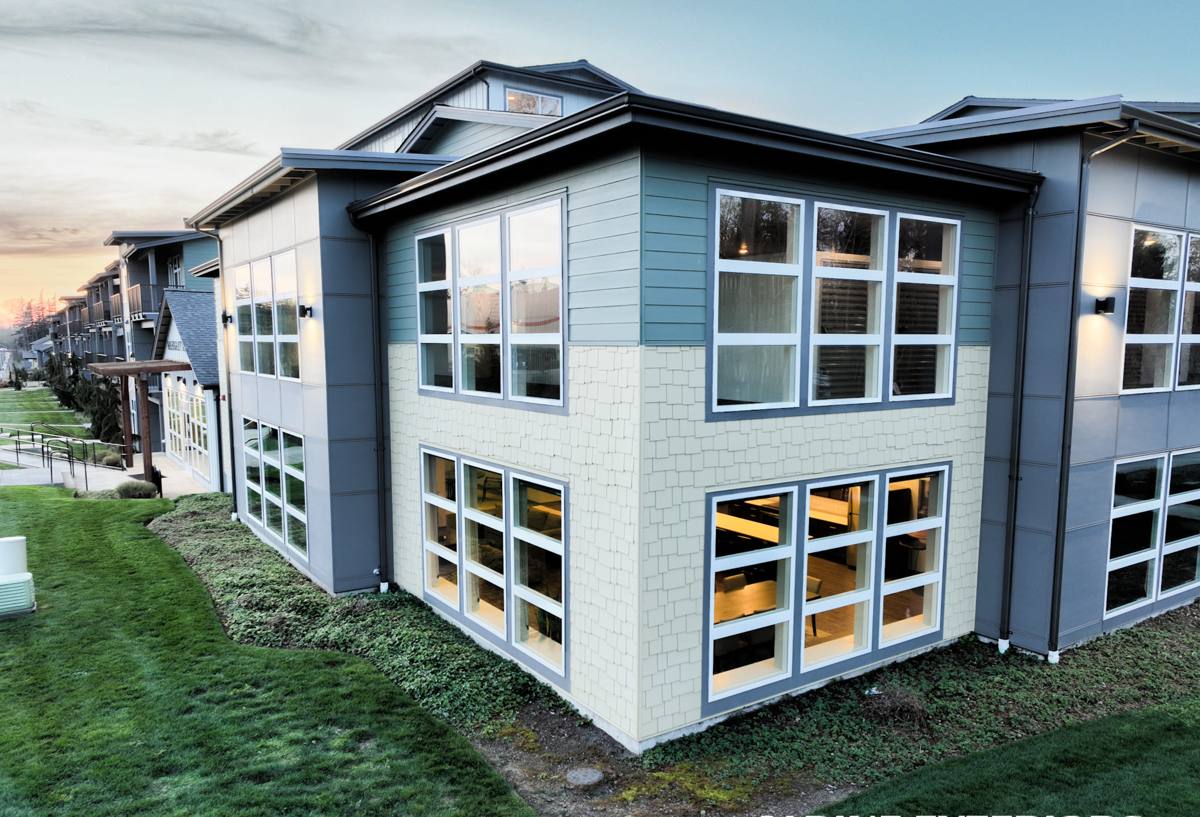
Why We Install Only James Hardie Fiber Cement
We don't offer vinyl, LP SmartSide, cedar, primed spruce, Cemplank, or Allura. That's a deliberate standard, not a lack of options. James Hardie fiber cement is non-combustible, dimensionally stable, and — when specified correctly for this region — engineered for the exact conditions Geneva homes face: sustained moisture exposure and cool, damp winters.
Hardie's HZ5 formulation is built for climate zones with more moisture and freeze-thaw cycling, which describes western Whatcom County well. The factory-applied ColorPlus finish is baked on under controlled conditions and carries its own finish warranty, which matters here specifically because field-applied paint on wood or engineered wood products is the first thing to fail under repeated wetting and drying. A moss-prone, rain-heavy climate is hard on any coating that isn't factory-cured.
We're not going to tell you every other siding product is worthless — vinyl is inexpensive and low-maintenance in mild climates, engineered wood has a warmer look, cedar has real appeal for the right homeowner who wants to maintain it. Our position is narrower: for the moisture load and salt exposure Geneva homes deal with, we don't think those trade-offs hold up over a 20-30 year ownership horizon, and we'd rather install one product correctly than offer several we can't fully stand behind.
What Geneva Homeowners Should Expect From the Material Itself
- Resists swelling, rotting, and delaminating from prolonged rain exposure
- Does not feed mold, mildew, or moss the way wood-based sidings can
- Holds paint/finish integrity far longer than field-painted alternatives
- Non-combustible — a real factor in a state with a growing wildfire-smoke and ember season
- Heavier and more rigid than vinyl, so it doesn't oil-can, warp, or rattle in coastal wind gusts
What a Correct James Hardie Installation Actually Involves
The product is only half the equation. A huge share of siding failures we get called to inspect — regardless of brand — trace back to installation shortcuts, not the material. In a climate like Geneva's, the assembly behind and around the boards has to actively manage water, not just resist it.
The details that matter most here
- Weather-resistive barrier and rainscreen gap: a drainage plane behind the siding lets any moisture that does get past the cladding drain and dry out instead of sitting against sheathing.
- Flashing at every penetration: windows, doors, hose bibs, light fixtures, and deck ledgers all need proper head flashing and kick-out flashing so wind-driven rain can't track behind the siding.
- Correct fastener type and placement: corrosion-resistant fasteners, driven to Hardie's specified depth and location — overdriven or underdriven nails are one of the most common causes of premature siding failure.
- Proper gapping and caulking: Hardie's own installation instructions specify gaps at butt joints and trim, sealed with a high-quality sealant rated for the exposure — not just caulked shut with no room to move.
- Starter strip and clearance from grade/decks/roofing: siding held too close to soil, concrete, or roof lines wicks moisture continuously, which is exactly how rot and moss get a foothold.
Skip any one of these and you can end up with a wall that looks fine from the curb for a year or two while trapped moisture does damage behind it — the kind of problem that costs far more to fix later than it would have to install right the first time.
Matching the Right Hardie Product to a Geneva Home
Not every Hardie product line is the right fit for every home, and matching profile and finish to the house and its exposure is part of doing this correctly.
| Hardie Product | Best Use on Geneva Homes | Why It Fits |
|---|---|---|
| HardiePlank Lap Siding | Most single-family homes, full elevations | Classic profile, widest color range, proven long-term performance in wet coastal climates |
| HardieShingle | Accent gables, dormers, feature walls | Gives a textured, coastal look without the moisture vulnerability of real wood shingle |
| HardiePanel (vertical) | Modern facades, garages, mixed-material designs | Clean lines for contemporary styling, pairs well with trim accents |
| HardieTrim | Corners, window/door surrounds, fascia | Matches siding durability so trim doesn't become the weak point in the system |
For homes closer to open water and higher wind exposure, we lean toward tighter fastening schedules and additional flashing detail regardless of which profile is chosen — the product line is a style decision, but the exposure category drives the installation spec.
Our Process for a Geneva Siding Project
- On-site assessment: we look at current siding condition, moisture staining, trim and flashing details, and any signs of moss or organic buildup that point to trapped moisture.
- Written scope and product plan: which Hardie products, colors, and trim details fit the home, with the specific flashing and drainage plan called out — not just a generic bid.
- Tear-off and sheathing check: we inspect sheathing condition as old siding comes off, since this is the only point in the project where hidden rot or moisture damage can be caught and repaired.
- Weather barrier and rainscreen installation: installed to manage water before the first piece of Hardie goes up.
- Siding, trim, and flashing installation: to Hardie's published fastening and clearance specifications.
- Final walk-through: caulking, paint touch-up at cut ends, and a check of every penetration and transition point.
Living With Hardie Siding in a Moss-Prone Climate
James Hardie siding doesn't feed organic growth the way wood or wood-composite products can, but no exterior surface in western Washington is completely immune to surface moss and algae — it settles on roofing, decking, and fences too. The practical difference is that on correctly installed Hardie siding, that growth stays on the surface rather than working into the material, so it washes off with a gentle rinse and doesn't compromise the board underneath. We recommend a periodic soft rinse-down, especially on north-facing and shaded walls where moss tends to establish first, and keeping gutters and downspouts clear so runoff isn't sheeting down the siding face.
Simple maintenance checklist
- Rinse siding (garden hose pressure, not a pressure washer) once or twice a year, more often on shaded elevations
- Keep plantings and mulch beds pulled back from direct wall contact
- Check caulking at trim and penetrations every couple of years and re-seal as needed
- Clear gutters before the fall rains so overflow doesn't run down the wall
- Have a contractor check flashing if you notice staining, bubbling paint, or a soft spot anywhere on the wall
Cost Factors for a Geneva Hardie Project
Every home is different, but the line items that move the price are consistent. We give firm, written numbers after a walk-through rather than a phone quote, because exposure, tear-off condition, and trim complexity all swing the total.
| Factor | Why It Matters |
|---|---|
| Tear-off and sheathing condition | Hidden rot found once old siding is removed adds repair cost but prevents a bigger problem later |
| Home size and wall complexity | More corners, gables, and trim detail mean more labor and material cuts |
| Product mix (lap, shingle accent, panel) | Mixing profiles for architectural interest adds labor over a single flat product run |
| Color | Standard ColorPlus colors vs. custom field-applied color affect price and lead time |
| Flashing and drainage upgrades | Homes with prior moisture issues may need added flashing or a rainscreen upgrade beyond baseline |
Why Hire a Crew That Already Works in Geneva
Siding crews that mostly work drier, inland regions sometimes install to a generic spec that doesn't account for wind-driven coastal rain or a long moss season — and it can take years for the shortcuts to show up as a problem. A crew that regularly works Whatcom County's wetter, water-adjacent neighborhoods already builds in the flashing, drainage, and fastening margin this climate calls for, without treating it as an upcharge or an afterthought. That familiarity with the specific way weather behaves in this part of the county is worth as much as the brand of siding going on the wall.
If you're weighing a siding replacement or new construction project in Geneva, we're happy to walk the home, look at what the current siding and trim are telling us, and put together a straightforward, no-pressure estimate for a correctly installed James Hardie system built for this climate.