 Sudden Valley Siding
 Siding Replacement in Sehome Has to Answer to the Weather, Not Just the Look
Sehome sits close enough to Bellingham Bay that salt-laden air is a constant, and far enough into the hills that tree cover keeps large sections of every roofline and wall in shade for long stretches of the year. That combination — salt air, driving rain off the water, and a moss season that can run from October into May — is harder on exterior siding than most homeowners realize until they're standing at the base of a ladder looking at soft trim boards or bubbled paint. A siding replacement here isn't just a cosmetic upgrade. It's a decision about what material and installation method will actually hold up to this specific stretch of Whatcom County for the next 30-plus years.
We work Sehome regularly, along with the rest of the Sudden Valley and greater Whatcom County area, and the failure patterns we see are consistent enough that we can usually tell you what's wrong with a home's siding before we finish walking the perimeter. That local pattern-recognition is worth more than it sounds like — it means less guessing, fewer surprises once the old siding comes off, and a spec that matches what actually survives here instead of what looks good in a showroom.
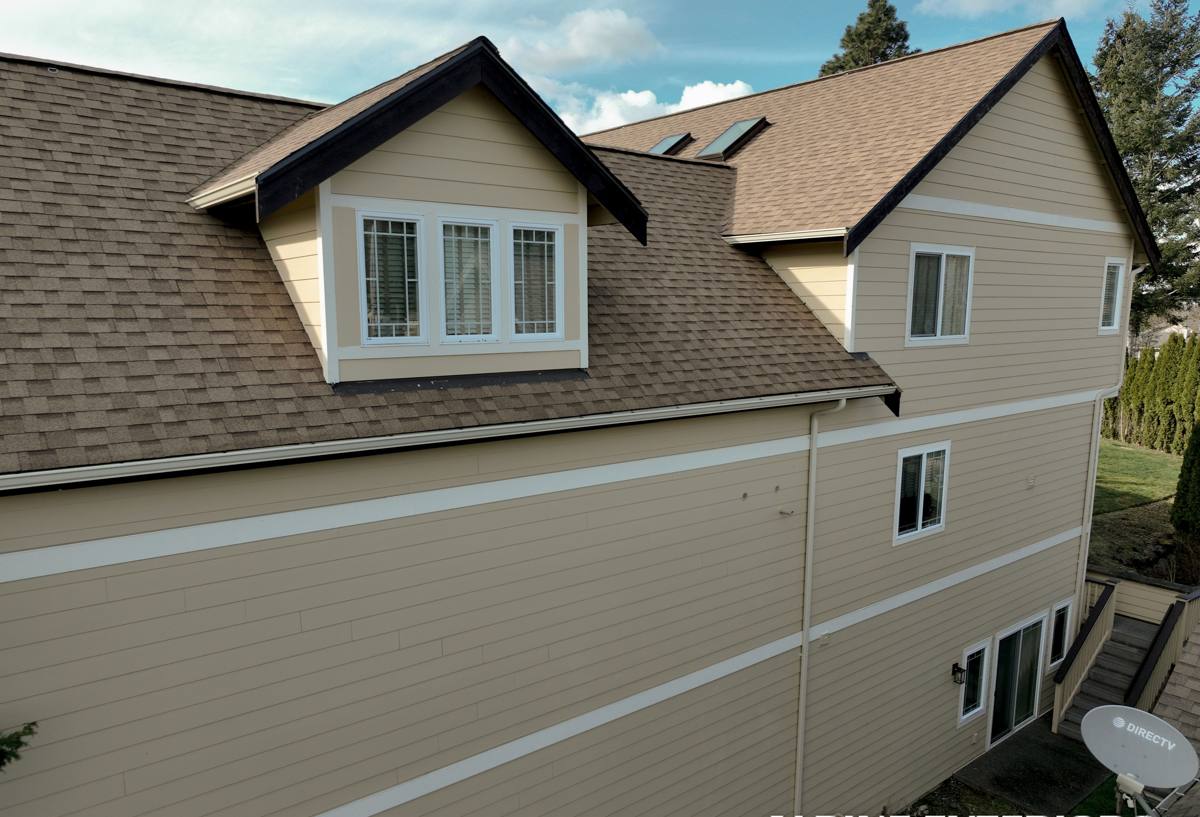
What Whatcom County's Climate Does to Siding Over Time
Salt air
Airborne salt from the bay accelerates corrosion on fasteners, flashing, and any metal trim components. It also degrades paint films faster than inland climates do, which is why homes closer to the water tend to need repainting sooner than the manufacturer's stated repaint interval would suggest — unless the siding's finish was engineered to resist it in the first place.
Driving rain
Wind-driven rain off the water doesn't just wet a wall surface — it drives moisture sideways and upward into laps, seams, and butt joints that were never designed to handle water moving in that direction. Siding systems and installation details that work fine in a calm-rain climate can fail here specifically because the water finds its way behind the cladding instead of running down the face of it.
Moss and prolonged dampness
Shaded, tree-covered lots stay damp for days after a storm has passed elsewhere. Moss and algae take hold on any surface that can't dry out between rain events, and once organic growth establishes itself on a porous or improperly sealed material, it holds moisture against the wall around the clock. Over years, that constant dampness is what actually causes rot, delamination, and paint failure — the moss itself is mostly a symptom pointing at a drying problem.
Checklist: Signs Your Sehome Home's Siding Is Due for Replacement
- Soft or spongy spots when you press on siding near the bottom courses, corners, or under windows
- Paint that's peeling, bubbling, or chalking well before the manufacturer's expected repaint interval
- Visible cupping, warping, or buckling of individual boards or panels
- Moss or dark streaking that returns within a season of being cleaned
- Gaps opening up at butt joints, corner boards, or trim where caulk has failed
- Visible fastener heads bleeding rust through the paint
- Interior signs — musty smell, peeling interior paint, or soft drywall on exterior walls
- Siding that's simply original to a home built more than 20-25 years ago and has never been replaced
What a Correct Siding Replacement Job Actually Involves
Pulling old siding off and nailing up new material is the easy part to see — it's not the part that determines whether the job lasts. Most siding failures we're called out to inspect trace back to what happened underneath the old cladding, not the cladding itself.
Tear-off and inspection
Once the old siding is off, we inspect the sheathing, framing, and existing weather-resistive barrier for rot, soft spots, or prior water damage. In a climate like this one, it's common to find damage concentrated around windows, at wall penetrations, and near ground level where splash-back keeps material wet longest. Any compromised sheathing or framing gets replaced before anything new goes back on — covering damaged wood with new siding just hides a problem that keeps getting worse.
Water-resistive barrier and flashing
A correctly detailed drainage plane behind the siding is what actually keeps a home dry — the siding itself is the first line of defense, not the only one. That means a properly lapped weather-resistive barrier, correctly flashed windows and doors, and flashing at every horizontal transition where water can be driven up and under by wind. Given how much wind-driven rain this area sees, cutting corners here is the single most common cause of siding replacements failing early.
Rainscreen or drainage gap
A ventilated gap between the water-resistive barrier and the new siding lets any moisture that does get past the cladding drain and dry out instead of sitting against the wall. For a climate with a moss season this long, that drying capacity is what separates a siding job that looks fine for five years from one that stays sound for thirty.
Installation to manufacturer spec
Correct fastener type and placement, proper clearances at grade and roofline, factory-mitered or properly caulked corners, and manufacturer-specified gaps at butt joints all matter more in a wet climate than a dry one, because any shortcut here becomes a water entry point. This is also where warranty coverage actually lives or dies — most manufacturer warranties are void if installation didn't follow their published instructions, whether or not that was ever disclosed to the homeowner.
Why We Install Only James Hardie Fiber Cement
We standardized on James Hardie fiber cement siding for every job we do, including here in Sehome, because it's the product that actually holds up to this combination of salt air, driving rain, and prolonged dampness without the maintenance burden that comes with wood-based or vinyl alternatives. Fiber cement doesn't rot, it doesn't provide the cellulose that moss and algae feed on the way wood-based products can, and it's non-combustible — a real consideration in a state where wildfire smoke and ember exposure have become a normal part of late-summer weather.
Hardie's ColorPlus factory finish is baked on under controlled conditions rather than field-applied, which matters directly for salt-air durability — a factory finish resists UV and salt degradation longer than a field-applied paint job, and it comes with its own finish warranty separate from the product warranty. Hardie also makes climate-specific HZ product lines engineered for different moisture and temperature profiles, so the specification we use here reflects what the Pacific Northwest actually throws at a wall, not a generic national default.
How Common Siding Materials Compare in This Climate
| Material | Moisture behavior | Moss/algae resistance | Maintenance | Typical lifespan here |
|---|---|---|---|---|
| James Hardie fiber cement | Dimensionally stable, doesn't absorb and swell | Doesn't feed organic growth; factory finish resists staining | Occasional wash; repaint per finish warranty interval | 30-50 years |
| Vinyl | Doesn't rot but can warp/crack in temperature swings; seams leak | Grows algae readily in shaded, damp spots | Low, but panels aren't repairable individually if damaged | 20-30 years, shorter with UV/salt exposure |
| Primed spruce/cedar (wood) | Absorbs moisture, prone to swelling and rot at joints | Cellulose feeds moss and fungal growth directly | High — regular repainting and caulking | 10-20 years before major repair |
| Engineered wood (LP-type) | Better than raw wood but still moisture-sensitive at cut edges | Can support growth if finish is compromised | Moderate — edge sealing and repainting | 20-30 years with diligent upkeep |
Our Process, Start to Finish
- Free on-site estimate — we walk the whole exterior, not just the obviously damaged sections, since Sehome's shaded and sun-exposed walls often age at very different rates on the same house.
- Written scope and product spec — exact Hardie product line, profile, and color, plus what happens with trim, flashing, and any sheathing repair allowance.
- Tear-off and structural inspection — old siding removed, substrate inspected, damage repaired before anything new goes up.
- Weather barrier, flashing, and rainscreen installation — the part of the job that determines whether it lasts.
- Hardie siding installation to manufacturer spec — correct fasteners, clearances, and joint treatment, which keeps the manufacturer warranty intact.
- Final walkthrough — we go over the finished work with you directly and leave you with warranty documentation.
Cost Factors for a Sehome Siding Replacement
| Factor | Why it moves the price |
|---|---|
| Extent of substrate damage found at tear-off | Rotted sheathing or framing found behind old siding needs repair before new siding goes on |
| House size, wall height, and story count | More square footage and difficult access (steep or wooded lots common in Sehome) increase labor |
| Trim, corner, and soffit detail complexity | More corners, window trim, and transitions mean more cutting and flashing work |
| Hardie product line and profile chosen | Lap width, texture, and HZ climate rating affect material cost |
| Color | Standard ColorPlus colors vs. custom field-painted options price differently |
| Rainscreen/drainage detailing | Proper drainage gap installation adds labor but is the right call in this climate |
We give exact numbers only after seeing the house — anyone quoting a firm price over the phone for a job like this hasn't seen what's actually behind your walls.
Why Hiring a Crew That Already Works Sehome Matters
A siding contractor who's only ever worked drier inland climates will spec and install the same way regardless of where the house sits. A crew that already works Sehome and the rest of Whatcom County knows to expect more moisture-driven substrate damage on shaded walls, to detail flashing for wind-driven rain rather than straight-down rain, and to talk you through why a rainscreen gap is worth the extra step here even though it's optional in plenty of other parts of the country. That local pattern-recognition shortens the surprises during tear-off and means the spec we hand you on day one is already built for the conditions your house actually faces, not a generic national average.
If your siding is showing any of the signs above, or you're just planning ahead for a home that's due, we'll come take a look and give you a straight, no-pressure estimate — no obligation, and no pressure to sign anything on the spot. The form below gets you on the schedule.