 Sudden Valley Siding
 Why Silver Beach Wears Out Siding Faster Than Inland Homes
Silver Beach sits close enough to the water that homes here take a different kind of weathering than houses a few miles inland. Salt-laden air off the water works its way into seams, fasteners, and any exposed wood fiber. Wind-driven rain hits walls at an angle instead of falling straight down, which means water gets pushed up under laps and around trim that would stay dry on a more sheltered lot. And because so many lots in this part of Whatcom County are wooded and shaded, homes go through a long moss season every year — sometimes eight or nine months where north- and east-facing walls barely see direct sun.
None of that is unusual for the Pacific Northwest. But it's a lot to ask of a wall covering, and it's why the siding choice on a Silver Beach home matters more than it would somewhere drier. Products that hold up fine in Spokane or Boise don't always hold up here, and the failures usually show up slowly — a soft spot behind a downspout, a seam that's stayed damp long enough to feed rot underneath, moss holding moisture against a wall for months at a stretch.
Salt Air and Driving Rain
Salt air accelerates corrosion on fasteners and metal flashing, and it degrades some paint finishes faster than inland exposure does. Driving rain is a bigger deal than most homeowners expect — it's the reason lap siding needs correct overlap and the reason caulk joints and trim details matter as much as the field of the wall. A siding job that looks fine on a calm, dry day can still be under-built for what a Silver Beach winter storm actually does to a wall.
Moss, Shade, and Standing Moisture
Moss itself doesn't destroy siding, but it holds water against the surface far longer than open sun and wind would allow it to dry. On wood-based products, that extended damp contact is exactly what starts rot. On the wrong composite products, it's what triggers swelling at cut edges and seams. Siding on shaded, tree-covered lots needs to tolerate being wet more often and for longer — not just survive an occasional storm.
Why We Install James Hardie and Nothing Else
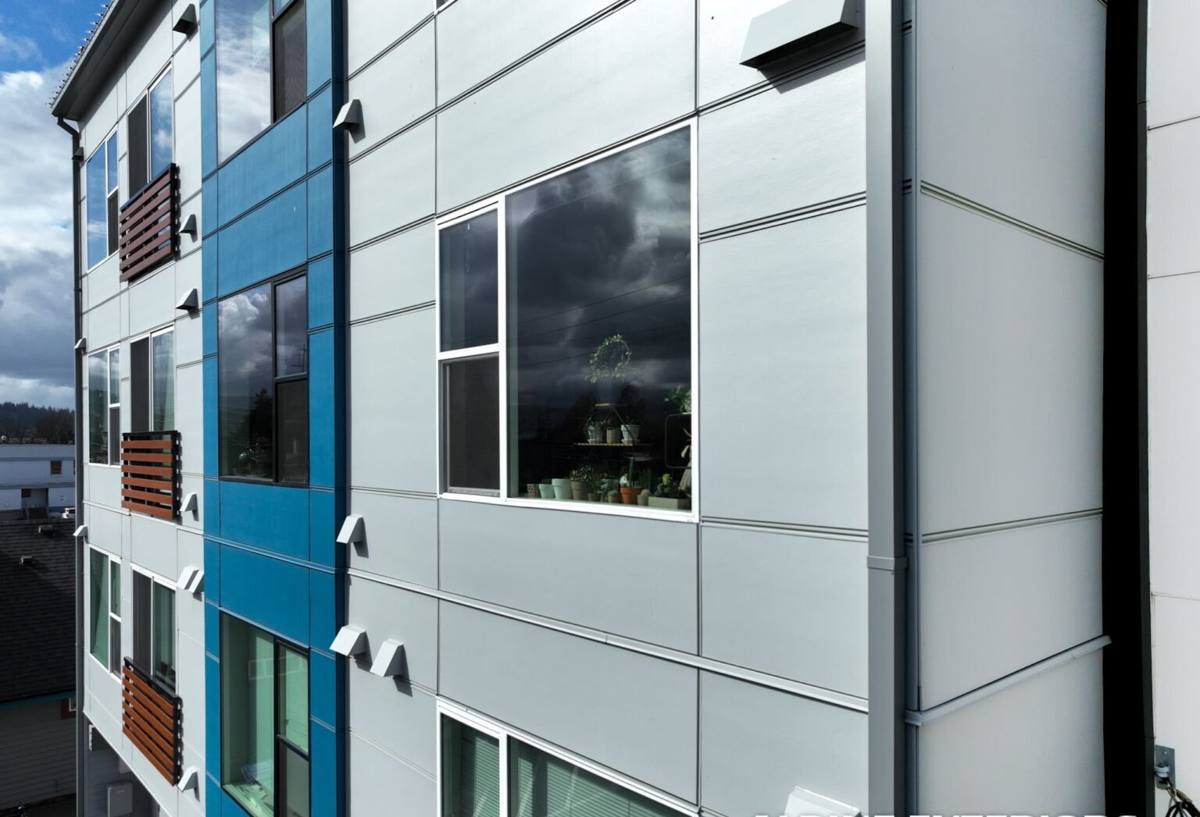
We standardized on James Hardie fiber cement siding for every job we do, including the ones in Silver Beach, because it's the product that actually holds up to this specific combination of salt exposure, driving rain, and prolonged shade. Fiber cement is made from sand, cement, and cellulose fiber — there's no wood fiber for moisture to feed on, so it doesn't rot, and it doesn't provide the organic food source that moss and mildew need to spread the way they do on wood-based siding.
We're not going to pretend every other siding product is unusable — vinyl, engineered wood, and other fiber cement brands all have a place in the market. But we've made a professional decision to install one product, install it correctly, and stand behind it, rather than stock five options and let a homeowner sort out which one fits their lot. For a climate like this one, Hardie's combination of moisture resistance, non-combustible composition, and factory-applied finish is the one we're comfortable putting our name on.
The HZ5 Product Line: Built for This Weather
James Hardie engineers its siding in regional formulations called HZ (HardieZone) products, and HZ5 is the version specified for cold, wet climates like ours — as opposed to HZ10, which is formulated for hot, humid Southern climates. HZ5 products are engineered with different moisture and freeze-thaw performance than the HZ10 line, which matters in a place that sees both prolonged damp weather and winter cold snaps.
For a Silver Beach home, that means the siding itself is matched to the job it has to do, not a generic national product installed the same way everywhere. We spec HZ5 on every job in this area as a baseline, not an upgrade.
What a Correct Installation Involves
Fiber cement siding performs the way it's supposed to only when the installation follows Hardie's published details. A lot of the problems we get called out to inspect on other contractors' work trace back to shortcuts in a handful of specific areas.
Water Management Behind the Siding
Correct installation starts with a weather-resistant barrier and properly lapped flashing at every window, door, and horizontal trim transition — installed so water is directed out and away from the wall assembly, never trapped behind it. This is the single most important part of the job in a driving-rain climate, and it's also the part that's invisible once the siding goes up, which is why it's worth asking about before hiring anyone.
Fastening and Clearances
Hardie's installation instructions specify fastener type, spacing, and how far each nail sits from the panel edge. They also specify a minimum clearance between the bottom edge of the siding and roof lines, decks, and grade — typically a couple of inches — so the material isn't sitting in standing water or constant splash-back. Skipping these clearances is one of the most common causes of edge damage we see on homes near the water.
Caulking and Joint Treatment
Butt joints, seams, and any place two pieces of siding or trim meet need to be treated according to spec — some joints are meant to be caulked, others are designed to be left as a shadow gap with flashing behind them. Caulking a joint that should be open (or leaving open a joint that needs to be sealed) creates exactly the kind of moisture trap that leads to problems down the road.
ColorPlus Finish vs. Field-Painted Siding
One of the practical advantages of Hardie siding in a salt-air, high-moss climate is the option to order it pre-finished at the factory with ColorPlus Technology, instead of painting it on site after installation. Here's how the two approaches compare for a home in this kind of environment:
| Factor | ColorPlus Factory Finish | Field-Applied Paint |
|---|---|---|
| Finish consistency | Baked-on in controlled conditions, uniform coverage | Depends on weather and application conditions on install day |
| Touch-up needs early on | Minimal; finish is cured before install | More common; fresh paint is more vulnerable to early moisture exposure |
| Fade/weathering resistance | Formulated specifically for the siding substrate | Varies by paint product and applicator |
| Warranty coverage | Finish is covered under Hardie's ColorPlus warranty | Typically covered separately by the paint manufacturer, if at all |
| Repaint cycle | Extended interval before repainting is needed | Standard exterior repaint cycle applies |
We default to ColorPlus finishes for Silver Beach jobs because the factory cure holds up better against salt air and near-constant dampness than a finish applied on site and left to cure in variable weather.
What Drives Cost on a Silver Beach Siding Job
Every home is different, but a few factors consistently move the price on jobs in this area more than they would on an easier lot:
| Cost Factor | Why It Matters Here |
|---|---|
| Existing siding removal | Rotted sheathing found underneath adds repair scope before new siding goes on |
| Site access | Wooded, sloped, or lake-facing lots often need extra staging and protection time |
| Trim and flashing detail | Homes with more windows, dormers, and roof transitions need more flashing labor |
| Panel profile and texture | Lap width and texture selection affect material cost, not just look |
| Finish choice | ColorPlus factory colors vs. custom field-applied paint changes both cost and timeline |
We walk every home before quoting so the estimate reflects what's actually behind the existing siding, not a guess.
Our Process for a Silver Beach Home
- Walk-through and inspection — we look at existing siding, trim, flashing, and any visible moisture damage before quoting anything.
- Written estimate — product line, panel profile, finish, and scope spelled out, no vague allowances.
- Removal and sheathing check — old siding comes off and we inspect the wall underneath before anything new goes up.
- Water barrier and flashing — installed to Hardie's published details at every penetration and transition.
- Siding installation — correct fastening, clearances, and joint treatment throughout.
- Final walk-through — we review the finished job with the homeowner before calling it done.
Maintaining Hardie Siding in This Climate
Fiber cement is low-maintenance compared to wood, but "low-maintenance" isn't "no-maintenance," especially with a long moss season working against you. A simple annual routine keeps a Hardie installation performing the way it's designed to:
- Rinse siding once or twice a year to clear salt residue, pollen, and organic buildup, especially on shaded walls
- Trim back branches and vegetation that keep any section of wall in constant shade or contact
- Check caulked joints around windows and trim annually for cracking or separation
- Clear gutters and downspouts before the wet season so water isn't overflowing onto siding below
- Watch for soft spots or discoloration near the bottom courses, where splash-back and standing water are most likely
- Repaint on the manufacturer's recommended cycle if the siding was field-painted rather than ColorPlus finished
Why Local Experience in This Area Matters
A crew that already works Silver Beach and the surrounding Sudden Valley area knows which walls take the worst of the weather, how wooded lots change drying time, and what flashing details actually get tested by this climate instead of just meeting code on paper. That's different from a crew installing siding here for the first time and applying a generic install everywhere they go. We install one product, we install it to spec, and we've seen what happens on this shoreline when either of those things gets skipped.
If you're weighing a siding replacement in Silver Beach, we're happy to walk the property, look at what's underneath the existing siding, and put together a straightforward, no-pressure estimate — just fill out the form below to get started.