 Sudden Valley Siding
 Why Decks in Edgemoor Wear Differently Than Decks a Few Miles Inland
Edgemoor sits along Bellingham Bay, and that shoreline position changes what a deck out here has to deal with compared to a similar deck built a few miles inland in Whatcom County. Open water means salt-laden air moving across the property more consistently, wind-driven rain that doesn't behave like straight-down rain, and — thanks to the mature tree cover common on Edgemoor lots — a moss and mildew season that runs long even by Pacific Northwest standards. A deck board or fastener that would perform fine on a dry, open inland lot can start showing problems years earlier out here, simply because it's being asked to handle more.
Composite decking is built specifically to hold up better than wood under that kind of pressure, but not all composite is engineered or installed the same way. This page covers what an Edgemoor deck actually needs given the local climate, what a correct composite installation involves, and why working with a crew that already builds decks in this specific stretch of Whatcom County matters more than it might seem.
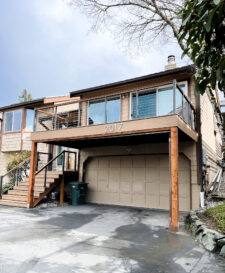
What This Climate Actually Does to a Deck in Edgemoor
Salt Air Off Bellingham Bay
Homes closer to the water pick up salt in the air even on calm days, and that salt settles onto every exposed surface, not just during storms. For a deck, the real damage shows up in the metal — fasteners, brackets, and railing hardware corrode faster in salt air than they do inland, and a fastener that's quietly losing holding strength doesn't always look bad from the surface. That's part of why fastener grade isn't a place to economize on a deck this close to open water.
Driving Rain and Wind Off the Water
Rain that comes in off Bellingham Bay tends to arrive with wind behind it, which pushes water sideways and up under board edges and railing connections in ways that straight-down rain doesn't. That matters most at the points where a deck meets the house — the ledger board attachment — and anywhere water can collect against framing instead of draining away from it. A deck built without that in mind can develop a moisture problem at the structure long before the visible boards show any wear.
A Long Moss and Mildew Season
Mature tree cover is part of what makes Edgemoor lots attractive, and it's also what keeps deck surfaces shaded and slow to dry through much of the year. Combined with the humidity off the bay, that shade keeps organic growth — moss, algae, mildew — active for a longer stretch of the year than a sunnier, more open property would see. Lower-quality or uncapped decking materials pick up staining and surface growth noticeably faster in that kind of environment, and once moss gets established in board grooves or fastener recesses, it holds moisture against the material even between rain events.
What "Composite Decking" Actually Means
Composite decking is generally a blend of wood fiber and plastic, but the ratio, the plastic type, and how the board is finished vary considerably between manufacturers. Two distinctions matter most for a property like this:
Capped vs. Uncapped
Capped composite boards have a protective plastic shell wrapped around a wood-plastic composite core, which keeps the core from absorbing moisture directly and resists staining and UV fade at the surface. Uncapped composite is the older style of the product — the wood-plastic blend is exposed on all sides, so it absorbs moisture more readily and is more prone to mold growth and surface wear. In a shaded, humid, salt-air environment like Edgemoor, that difference shows up faster than it would on a dry inland lot, which is why we standardize on capped composite here.
Board Color and Cap Quality
Darker composite boards absorb more heat and, on lower-quality caps, can show fading and chalking sooner under UV exposure. In a shaded setting like most Edgemoor lots, UV degradation is less of a driving concern than moisture and organic growth — but cap quality still affects how well a board resists staining from tannins, pollen, and the moss and mildew that this climate produces. We walk through board color and product line options with that trade-off in mind rather than picking on looks alone.
What a Correct Composite Deck Build Involves Here
The visible decking gets most of the attention, but on a shaded, salt-exposed, bayfront-adjacent property, the substructure and fastening details are what actually determine whether the deck holds up over time. A build done right for Edgemoor conditions includes:
- Framing material rated for sustained moisture exposure — pressure-treated lumber suited to ground contact and damp conditions, or an alternative substructure where the site calls for it
- Stainless steel or coated corrosion-resistant fasteners throughout, not standard-grade hardware that corrodes faster in salt air
- Hidden fastener systems on the visible deck surface where the product allows, which reduces exposed metal and keeps the surface cleaner
- Correct board gapping for expansion, contraction, and drainage — composite still moves with temperature and moisture, just differently than wood
- Proper ledger board flashing and attachment where the deck ties into the house, since wind-driven rain concentrates at that connection
- Joist spacing matched to the specific composite product's span rating rather than a generic wood-framing spacing
- Railing and post attachment sized appropriately for the site's wind exposure, especially on decks with open bay-facing sides
- Ventilation and drainage beneath the deck so moisture doesn't sit against the framing through the wet months
Skipping any one of these rarely causes an obvious problem right away. It shows up a few years in, as a soft spot in the framing, a railing post that's started to loosen, or fasteners corroding enough to stain the boards around them.
How Our Process Works
We start with a site visit to look at what's actually there — existing framing condition on a replacement, how much shade the deck area gets through the day, drainage and grade around the site, and how directly it faces the bay. From there we talk through composite product options that fit the budget and how the space will actually be used, whether that's a quiet spot to sit or a deck built around entertaining.
Permitting for deck work in Whatcom County and the City of Bellingham generally follows standard residential building code requirements, and we handle that process as part of the job rather than leaving it to the homeowner to sort out. Once permitted, the build follows the sequence above — substructure first, with every framing and fastening decision made for the site's actual exposure, then the composite surface, railing, and any trim work. We finish with a walkthrough covering what the specific product you chose actually needs going forward, which is minimal, but not literally nothing.
Composite Decking Compared to the Alternatives
| Material | How It Handles Salt Air, Rain & Moss | Maintenance | Typical Fit for Edgemoor |
|---|---|---|---|
| Capped composite | Strong — cap layer resists moisture absorption and surface staining | Periodic washing; no sealing or staining | Our standard recommendation for shaded, bayfront-adjacent lots |
| Cellular PVC | Excellent — no wood fiber to absorb moisture at all | Periodic washing; no sealing or staining | Worth considering on very damp or heavily shaded sites, at a higher upfront cost |
| Uncapped composite | Moderate — absorbs some moisture, more prone to mold and mildew staining | More frequent cleaning to manage organic growth | Shorter service life than capped products in this climate |
| Pressure-treated wood | Weak against sustained dampness — fasteners corrode faster, surface holds moisture | Regular sealing or staining required | Highest ongoing upkeep of the common options |
| Cedar | Attractive natural option, but absorbs moisture readily without upkeep | Periodic oiling or sealing to prevent graying and rot | Needs consistent maintenance to hold up under heavy tree cover |
What Composite Decking Still Needs From You
Composite decking is low-maintenance compared to wood, not maintenance-free — especially under Edgemoor's tree cover and bay humidity. A little routine care goes a long way:
- Rinse or wash the surface periodically to clear salt residue, pollen, and organic buildup before it stains the cap layer
- Keep board gaps clear of leaves and needles so water and airflow can move through as designed
- Check railing posts and visible hardware once or twice a year for early corrosion or loosening
- Trim back overhanging branches or landscaping that hold moisture against the deck edge or block airflow underneath it
- Address any substructure concerns — soft framing, standing water underneath — right away rather than waiting, since that's structural, not cosmetic
Why It Matters That We Already Work Edgemoor
A crew that mostly builds decks on dry, open inland lots can still install composite decking competently, but Edgemoor properties carry a specific combination of factors that don't come up as often elsewhere — salt exposure from being close to Bellingham Bay, wind-driven rain that hits ledger connections harder than a sheltered lot ever would, and heavy tree cover that keeps surfaces damp and prone to moss longer than most of Whatcom County sees. Working this neighborhood regularly means we're not guessing at those conditions or learning them on your project. We know what fastener grade actually holds up here, how to detail a ledger connection for driving rain off the water, and which composite lines resist moss and mildew staining rather than just looking good in a showroom.
That familiarity also means a straighter conversation about what your deck actually needs versus what's just an upsell — including being honest when a lower-tier product would leave you doing more maintenance than most homeowners want to sign up for on a shaded, bayfront-adjacent lot.
A Quick Checklist Before Hiring for Deck Work in Edgemoor
- Ask what fastener grade they use and whether it's rated for salt-air exposure
- Ask how they detail ledger board flashing where the deck ties into the house
- Confirm current Washington contractor licensing and active liability insurance
- Ask about experience with shaded, tree-covered lots specifically, not just decks in general
- Get a clear, written scope of work before signing anything
Get a Straight Answer About Your Deck
Whether you're replacing a tired wood deck, building new, or just want an honest read on what a composite deck would actually take on your Edgemoor property, we're happy to walk the site with you and lay out the options plainly. Reach out below for a free, no-pressure estimate.