 Sudden Valley Siding
 Energy-Efficient Windows for South Hill: Built for What This Site Actually Gets Hit With
South Hill sits exposed in ways that a lot of nearby, more sheltered lots simply don't — elevation and open exposure mean wind gets more of a run-up before it reaches the house, driving rain hits walls and glazing at more of an angle, and salt air off the water works on hardware and finishes year-round rather than occasionally. Add in Whatcom County's long, mild, wet stretch of the calendar and you get a window that's under real, sustained load almost every month of the year, not just during the odd winter storm. We install and replace windows throughout South Hill and the surrounding Sudden Valley area, and the specification and installation approach we use here is built around that exposure specifically — not a generic climate-zone default.
"Energy-efficient" gets used loosely in this industry. On a South Hill property it has to mean something concrete: a window that keeps conditioned air in, keeps wind-driven moisture out, and keeps performing that way after a decade of salt air and winter storms — not just a window that tested well in a lab under ideal conditions.
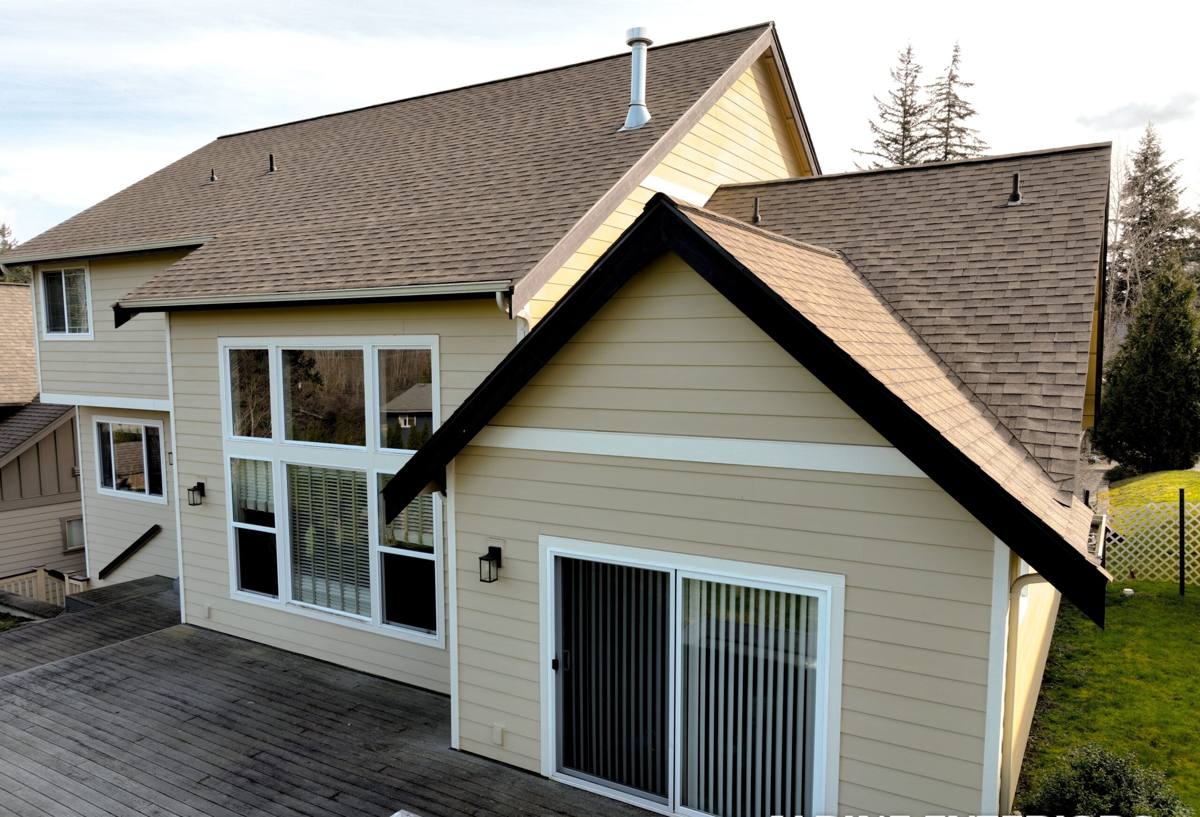
What This Site Does to a Window Over Time
Salt Air and Hardware Corrosion
Salt-laden air moves through this part of Whatcom County more than most homeowners realize, and it's hard on anything metal that isn't rated for it. Cheaper hinges, cranks, locks, and even fasteners inside the frame can start corroding years before the glass or the frame itself shows any wear, and once hardware binds or seals start failing at the moving parts, the whole unit's efficiency drops even though the window "looks" fine from the curb. This is one of the most overlooked failure points on an otherwise good window, because it happens out of sight.
Driving Rain and Wind-Loaded Elevations
An open, elevated lot like a typical South Hill property takes wind-driven rain harder than a sheltered, tree-buffered site does. Water gets pushed sideways and upward into gaps that would never see moisture on a calmer wall, which means the flashing and sealant details around a window matter as much as the window's own rating. A well-built window with a rushed installation will still let water in during a hard blow, and once moisture gets behind the frame, it undermines both the seal and the insulation around it.
A Long Moss and Mildew Season
Whatcom County's mild, damp stretch of the year runs long, and window sills, tracks, and exterior trim are exactly the kind of horizontal and shaded surfaces where moss and mildew get a foothold if water isn't shedding cleanly away. On an exposed site, that debris and moisture buildup around the frame can quietly work into gaps in the sealant over a season or two, which is one more reason drainage detailing at the sill deserves real attention, not just at install but on a maintenance cycle after.
What "Energy-Efficient" Actually Means
A handful of numbers on a spec sheet tell you almost everything you need to know about how a window will perform here. We walk every homeowner through these rather than just pointing at a price tag.
- U-factor: Measures how much heat the window lets through — lower is better for keeping conditioned air inside during Whatcom County's long cool, damp season.
- Solar Heat Gain Coefficient (SHGC): Measures how much solar heat passes through the glass — on a cloudy, mild climate like this one, the ideal number is different than it would be in a sunbaked region, and we size it to the home's actual sun exposure rather than a one-size-fits-all default.
- Low-E coatings: A microscopically thin coating that reflects heat while still letting light through — standard on any window worth installing today.
- Gas fill and spacer type: Argon or krypton fill between panes improves insulation, and the spacer holding the panes apart matters too — a poor spacer becomes a cold, condensation-prone edge over time.
- Air infiltration rating: Measures how much air leaks through the assembly itself — critical on a wind-exposed site like South Hill, where a poorly rated unit will leak measurably more than the same window on a sheltered lot.
Signs Your Current Windows Are Losing You Energy
Most homeowners don't replace windows because of one dramatic failure — it's usually a collection of smaller signs that add up. Worth checking before deciding whether repair, resealing, or full replacement makes sense:
- Noticeable draft or cold air near the window frame even when it's fully closed and locked
- Condensation or fogging between the panes, which means the seal has failed and the insulating gas has escaped
- Visible corrosion or stiffness in the hardware — locks, cranks, or hinges that used to move smoothly
- Water staining, soft wood, or bubbled paint on the interior or exterior trim around the frame
- A heating bill that's crept up without a clear explanation, especially on a home with older single-pane or early double-pane units
- Visible moss, algae, or persistent grime buildup at the sill that doesn't fully dry between rain events
What a Correct Installation Involves on a Site Like This
The window unit itself is only part of the performance equation. Installation quality decides whether that rating on the spec sheet actually holds up once the window is in the wall and taking weather on an exposed lot.
Flashing and Water Management
Every window opening needs flashing sequenced so water is directed out and down, never trapped behind the frame. On a wind-exposed elevation, we pay particular attention to the sill pan and the head flashing above the unit, since those are the two spots most likely to see wind-driven rain pushed against and even slightly upward into the assembly.
Air Sealing Around the Frame
A window can carry an excellent U-factor and still underperform badly if the gap between the frame and the rough opening isn't sealed correctly. We use appropriate low-expansion foam or backer rod and sealant around the full perimeter, not just a bead of caulk at the visible trim line, so the insulating value of the unit isn't undercut by air leaking around it.
Hardware and Fastener Selection
Given the salt exposure this area sees, we specify corrosion-resistant fasteners and hardware rated for coastal or marine-adjacent conditions rather than standard-grade components. It costs a little more upfront and saves homeowners from replacing failed hardware, or worse, dealing with water intrusion at a corroded fastener point, years down the line.
Frame Materials: Trade-Offs for This Climate
| Frame Material | Performance in Salt Air / Driving Rain | Maintenance | Typical Trade-Off |
|---|---|---|---|
| Vinyl | Good moisture and corrosion resistance; won't rot or rust | Low | Wide efficiency range — quality varies significantly by manufacturer |
| Fiberglass | Excellent dimensional stability; holds up well to wind and moisture cycling | Low | Higher upfront cost than vinyl |
| Aluminum | Strong but conducts heat and cold, and is more prone to corrosion near salt air unless properly finished | Moderate | Rarely our first recommendation for this exposure |
| Wood / wood-clad | Attractive but moisture-sensitive; needs a well-maintained exterior cladding to survive here | High on exposed elevations | Best reserved for sheltered walls or where interior wood appearance is a priority |
What Drives Cost on a South Hill Window Project
We won't quote a number without seeing the openings in person, but the factors that move price are consistent from project to project. Broad ranges only — every home is different.
| Factor | Why It Matters |
|---|---|
| Frame material | Vinyl, fiberglass, and wood-clad units carry different material and manufacturing costs |
| Number and size of openings | A whole-house replacement typically has better per-unit economics than a handful of individual swaps |
| Glass package | Upgraded low-E coatings, gas fills, and impact considerations add cost but pay back in comfort and durability on an exposed site |
| Opening condition | Rot, old flashing failures, or out-of-square framing found during removal add repair scope before the new unit goes in |
| Exposure of the specific wall | Wind- and rain-facing elevations sometimes warrant upgraded hardware or a more robust flashing detail than sheltered walls |
| Trim and finish work | Matching existing exterior trim and siding adds labor, especially on older homes |
Our Process
- On-site assessment — we look at each opening's exposure, existing frame condition, and any signs of past water intrusion before recommending anything
- Honest recommendation — the frame material and glass package that fits the home's exposure and the homeowner's priorities, explained plainly
- Clear, written scope and timeline — before any contract is signed
- Careful removal — old units come out without damaging the surrounding wall, and any hidden rot or flashing failure gets addressed rather than covered over
- Installation, flashing, and air sealing — done to the standard this exposure requires, not the minimum the manufacturer's average-condition guide describes
- Trim and finish — integrated to match the rest of the home's exterior
Why a Crew That Already Works South Hill Matters
Manufacturer installation instructions are written for average conditions in an average climate. South Hill isn't that — the combination of elevation, wind exposure, driving rain, and sustained salt air asks more of both the window and the installer than a sheltered inland lot would. A crew that already works this specific area knows which elevations typically need extra sill flashing, which hardware grade actually holds up here instead of corroding early, and where a shortcut installation shows up as a leak or a failed seal two or three years later rather than on day one. That's the kind of judgment that doesn't show up on a spec sheet — it shows up in whether the window is still performing the way it should after several winters of real Whatcom County weather.
A Quick Checklist Before Hiring for Window Work Here
- Ask what U-factor, SHGC, and air infiltration ratings they're specifying, and why, for your specific exposure
- Confirm current Washington contractor licensing and active liability insurance
- Ask how they handle flashing and sill drainage on wind- and rain-facing walls specifically
- Ask what hardware and fastener grade they use given the salt air in this area
- Get a clear, written scope of work — including who's responsible if hidden rot or damage is found during removal
- Confirm whether the window unit and the installation labor carry separate warranties
Ready to Talk About Your Windows?
If your windows are drafty, fogged, corroding at the hardware, or you're planning ahead for a full replacement, it's worth having someone look at the actual openings and their exposure before you start comparing quotes. We offer free, no-pressure estimates for window projects in South Hill and throughout the Sudden Valley area — use the form below to get a time on the schedule.