 Sudden Valley Siding
 Why Happy Valley Roofs Wear Differently Than Roofs Inland
If you've owned a home in Happy Valley for more than a few years, you've probably already noticed your roof doesn't age the way roofs do on the other side of Bellingham. Being close to Lake Whatcom and the broader Whatcom County marine climate means your roof deals with a specific combination of stressors: salt-tinged air moving off the water, long stretches of driving rain angled by wind, and a moss season that can run eight or nine months out of the year in shaded, north-facing sections. None of these individually is unusual for Western Washington. Together, on a roof that's aging or was built with standard-grade materials, they add up faster than most homeowners expect.
A new roof installation in this area isn't just about swapping old shingles for new ones. It's about choosing materials, underlayment, ventilation, and detailing that are matched to what a Happy Valley roof actually experiences year-round. That's the lens we bring to every roof we install here — not a generic package, but a system built for this specific microclimate.
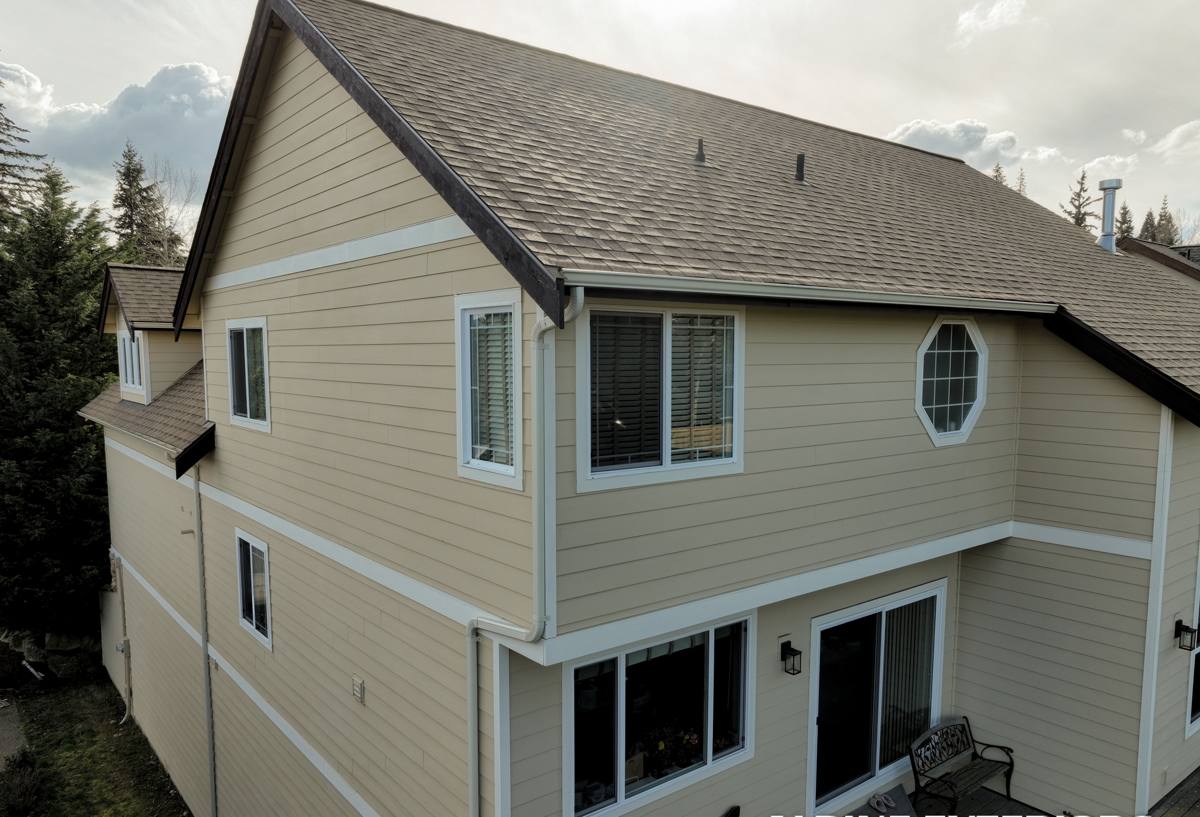
What Local Conditions Do To an Under-Built Roof
Moss and Organic Growth
Moss doesn't just look bad — it holds moisture against the roofing material, works its way under shingle tabs, and lifts fasteners over time. In shaded areas of Happy Valley, especially roof sections under tree canopy or facing north, moss can establish within a couple of years on a roof that isn't detailed to resist it. Once moss gets a foothold, granule loss accelerates and the roof's effective lifespan drops.
Wind-Driven Rain
Rain that comes in sideways during a winter storm tests every seam, flashing point, and fastener on a roof. Standard installation shortcuts — underlayment that isn't sealed at laps, flashing that's caulked instead of properly stepped, nail patterns that don't match the manufacturer's high-wind spec — tend to show themselves first at the eaves, valleys, and any place the roof meets a wall or chimney.
Salt Air and Metal Corrosion
Proximity to Lake Whatcom and the broader Puget Sound air pattern means metal components on a roof — flashing, fasteners, vents — are exposed to more corrosive moisture than a roof thirty miles inland. Uncoated or low-grade fasteners can start showing rust streaks on the roof surface within a few years, which is both a cosmetic problem and an early warning that the metal itself is degrading.
What a Correctly Installed Roof Includes
A new roof is a system, not a single product. Every layer has a job, and skipping or downgrading any one of them shows up later as a leak, a moss problem, or a shortened lifespan. Here's what we consider non-negotiable on a Happy Valley installation:
- Full tear-off to the decking — we don't install over existing layers; it traps moisture and hides deck damage.
- Deck inspection and repair — any soft, delaminated, or water-stained sheathing gets replaced before anything new goes down.
- Ice-and-water shield at vulnerable zones — eaves, valleys, and roof-to-wall transitions get a self-adhering waterproof membrane, not just felt.
- Synthetic underlayment across the field — more tear-resistant and consistent than old-style felt, and it holds up better during the install if weather turns while the crew is working.
- Balanced attic ventilation — intake at the eaves, exhaust at the ridge, sized to the attic volume. Ventilation is what keeps moisture from condensing under the deck and driving premature rot.
- Corrosion-resistant flashing and fasteners — matched to the salt-air exposure this area gets, not the minimum spec used further inland.
- Algae-resistant shingle or roofing material where appropriate — reduces how fast moss and organic growth can re-establish after installation.
Roofing Material Options for Happy Valley Homes
There isn't one "correct" roofing material for every home — it depends on your roof's pitch, sun and shade exposure, your budget, and how long you plan to stay in the home. We'll walk through the real trade-offs with you rather than pushing one product. Broadly, homeowners in this area are choosing between a few categories:
| Material | Typical Lifespan | How It Handles This Climate |
|---|---|---|
| Architectural asphalt shingle | 25–30 years | Good moisture and wind performance when installed with proper underlayment; algae-resistant granules help with moss/organic growth |
| Standing seam metal | 40–50+ years | Excellent shedding of driving rain and moss resistance on steeper pitches; requires corrosion-rated fasteners near the lake |
| Composite/synthetic shingle | 30–50 years | Resists moisture absorption and organic growth well; higher upfront cost, low long-term maintenance |
| 3-tab asphalt shingle | 15–20 years | Lower upfront cost but least wind and moss resistance; we'll be honest if this isn't the right long-term fit for a shaded or exposed roof |
We don't install every product in this table on every home. If a roof section stays shaded most of the day or sits low-pitch where water and debris linger, we'll usually steer you away from budget-tier shingle toward something with better moss resistance — not because the cheaper option is defective, but because it's a poor match for that specific exposure, and we'd rather tell you that upfront than have you replace a roof again in twelve years.
Our Installation Process
1. On-Site Assessment
We inspect the existing roof, attic ventilation, decking condition, and any problem areas — valleys, chimney flashing, skylights, low-slope sections — before we ever talk materials or price. We also look at how much shade and moss exposure your specific roof faces, since that varies a lot even between neighboring homes in Happy Valley.
2. Material Recommendation and Written Estimate
You get a written scope covering material, underlayment, ventilation plan, flashing detail, and a clear price — no vague allowances. We'll explain why we're recommending a specific product for your roof's exposure rather than handing you a one-size-fits-all quote.
3. Tear-Off and Deck Repair
Full removal of the old roofing down to the deck, disposal included, with any damaged sheathing replaced and documented before we move forward — no surprises added after the fact for something we should have caught upfront.
4. Weatherproofing Layer
Ice-and-water shield at eaves, valleys, and penetrations; synthetic underlayment across the field, properly lapped and sealed. This layer is what protects your home if a storm rolls through mid-project — it happens here more than most homeowners realize.
5. Roofing Installation
Material installed to manufacturer spec for fastener pattern, exposure, and flashing — the details that determine whether your warranty actually holds up if you ever need to use it.
6. Ventilation and Final Detail
Ridge and soffit ventilation balanced, flashing sealed at all penetrations, and a full site cleanup including magnetic sweep for stray fasteners.
7. Walkthrough and Documentation
We walk the finished roof with you, explain what was done, and provide documentation for your manufacturer and workmanship warranties.
How Long It Takes and What to Expect
Most residential re-roofs in this area take one to three days once work begins, depending on roof size, pitch, and how much deck repair is needed. Weather is the biggest variable — we don't tear off more roof than we can dry-in the same day, which sometimes means adjusting the schedule around a wet forecast rather than rushing and leaving your home exposed overnight. That's a deliberate choice, not a delay we apologize for.
During the project, expect noise, some vibration inside the house, and debris collection in a dumpster or trailer staged on your property. We protect landscaping and gutters as part of the standard process, and we do a full cleanup pass, including a magnetic sweep of the ground, before we consider the job finished.
Signs Your Roof May Need Replacement Rather Than Repair
- Granules collecting in gutters or at downspout outlets in noticeable amounts
- Shingles that are curling, cracking, or missing in multiple areas rather than one isolated spot
- Moss or algae covering more than a small patch, especially on north-facing slopes
- Daylight visible through the roof deck from inside the attic
- Water stains on ceilings or attic sheathing after a heavy rain event
- A roof that's already had multiple patch repairs in the last few years
- Soft or spongy spots when walked on decking during inspection
If you're only seeing one or two of these, a repair may still make sense. If you're seeing several at once, or your roof is already past 20–25 years old, a full replacement is usually the more cost-effective path — patch repairs on an aging roof tend to become a recurring expense rather than a fix.
Why Local Installation Experience Matters
A roofing crew that works Whatcom County regularly knows things a crew from outside the area has to learn on your roof: which flashing details actually hold up against lake-effect wind, how much ventilation a moss-prone shaded roof needs compared to a sun-exposed one, and which fastener grade is worth the extra cost this close to the water. That knowledge doesn't come from a manufacturer install guide — it comes from seeing how roofs in this specific area actually perform over years, including the ones that were installed wrong the first time and had to be fixed.
We also know the practical side of working in Sudden Valley and the surrounding Happy Valley area — narrow driveways, HOA expectations where they apply, and scheduling around the wetter months so your roof isn't left exposed longer than necessary. It's the kind of local familiarity that shows up in the quality of the finished job, not just the sales pitch.
Ready to Talk About Your Roof?
If your roof is showing its age, dealing with recurring moss, or you've had a leak you'd rather solve permanently than patch again, we're happy to take a look. We'll give you a straight assessment of what your roof actually needs, walk you through material options suited to your home's specific exposure, and provide a clear, no-pressure written estimate — no obligation to move forward. Use the form below to request your free estimate.