 Sudden Valley Siding
 Why Siding Repair Works Differently in Bellingham and Sudden Valley
Homes around Bellingham and out at Sudden Valley on Lake Whatcom deal with a specific combination of weather that most siding was never designed for. You've got salt-laden air moving in off Bellingham Bay and the Sound, long stretches of driving rain off the water, and a moss and algae season that can run eight or nine months out of the year in the shaded, tree-covered lots common to this part of Whatcom County. None of that damage happens overnight. It shows up as a slow accumulation — a soft spot behind a downspout, a stretch of green-black staining on the north wall, a seam that's opened up just enough to let water behind the board. By the time it's visible, there's often more going on underneath than what you can see from the ground.
That's the core difference between repairing siding here and repairing it somewhere dry and mild: in this climate, a repair that only addresses the cosmetic damage and ignores the moisture path behind it is a repair that fails again in a year or two. Doing it right means understanding how water moves on a Whatcom County exterior, not just patching what's cracked or missing.
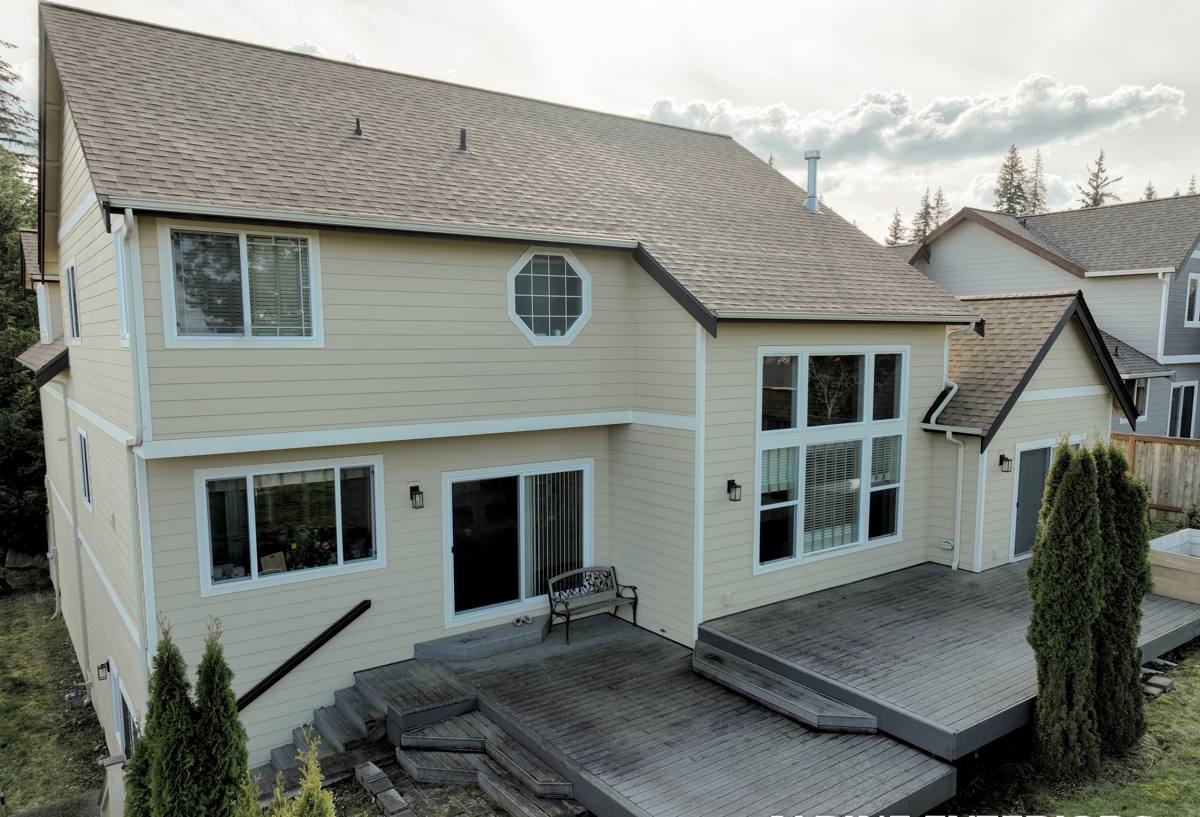
Signs Your Siding Needs Repair — Not Just a Wash
A lot of Bellingham and Sudden Valley homeowners call us after a pressure wash or a moss treatment didn't solve the problem. Here's how to tell the difference between surface staining and an actual repair need:
- Boards that feel soft, spongy, or give slightly when pressed near the bottom edge or around windows
- Paint or finish that's bubbling, peeling, or chalking in patches rather than evenly across the wall
- Visible gaps at seams, corners, or where siding meets trim, flashing, or the foundation
- Persistent moss or algae growth that returns quickly after cleaning, especially on north- and west-facing walls
- Warping, cupping, or bowing of individual boards or panels
- Cracked or missing caulk at butt joints and penetrations (vents, hose bibs, light fixtures)
- Interior signs — a musty smell, discoloration on interior drywall, or a spike in heating costs — that point to moisture getting past the exterior wall
Any one of these on its own might be minor. Several together, especially on the weather side of the house, usually means water has been getting behind the cladding for a while.
What a Correct Siding Repair Actually Involves
Assessment Before Anything Gets Touched
A repair that starts with cutting out a bad board before checking what's behind it is a repair that's likely to be redone. On homes in this region we start by opening up the damaged section enough to look at the water-resistive barrier, the flashing details, and the framing underneath. Whatcom County's rain volume means that if the drainage plane behind the siding has failed, the visible damage on the surface is usually just the tip of it.
Matching Materials the Right Way
If the existing siding is still sound and simply needs a section replaced, matching profile, reveal, and finish matters — a mismatched patch stands out and can create its own water-shedding problems at the seam. If the existing material is failing more broadly (wood siding delaminating, older composite breaking down, or repeated moss and rot in the same spots), a patch is a short-term fix on a long-term problem, and that's worth saying plainly rather than charging for a repair that won't hold.
Water Management Details
Proper repair work includes checking and correcting flashing at windows, doors, and horizontal trim; re-caulking joints with the right sealant; and making sure kick-out flashing directs roof runoff away from the wall instead of behind it. These details are what actually determine whether a repair lasts five years or fifteen in a climate that gets this much sustained rain.
Common Repair Scenarios We See Around Bellingham and Sudden Valley
| Scenario | What's Usually Happening | Typical Fix |
|---|---|---|
| Green-black staining that returns fast | Shaded, low-airflow wall holding moisture; moss/algae regrowth | Clean, treat, and evaluate whether drainage or trim details need correcting |
| Soft board near ground level | Splashback, poor grading, or failed caulk letting water wick upward | Cut out and replace affected section; correct grading or add flashing |
| Cracking at butt joints | Old or incompatible caulk, or board movement from moisture cycling | Re-seal with appropriate sealant; replace boards if movement has caused damage |
| Warping or cupping panels | Moisture absorption in wood-based or composite siding | Section replacement; often a signal the material is nearing end of service life |
| Damage around window/door trim | Missing or deteriorated flashing at penetrations | Flashing correction plus siding repair, not siding repair alone |
Repair or Replace? A Straight Answer
Not every siding problem needs a full re-side, and we won't tell you it does. But there's a point where repeated repairs cost more over time than replacing the siding once, correctly. Here's how we help homeowners think through it:
| Factor | Leans Toward Repair | Leans Toward Replacement |
|---|---|---|
| Extent of damage | Isolated to one or two areas | Spread across multiple walls or elevations |
| Age of existing siding | Under 10-15 years, otherwise sound | Original siding is decades old or already patched before |
| Material condition | Surrounding boards are solid | Delamination, rot, or warping is showing up in new spots each year |
| Underlying moisture barrier | Intact where inspected | Compromised or original barrier is failing broadly |
| Cause of damage | One-time event (impact, isolated flashing failure) | Ongoing exposure issue (chronic moss, driving rain on an exposed wall) |
We'll always give you the honest read on which side of that table your home falls on — a repair that's going to need redoing in two years isn't a favor to anyone.
Why We Only Repair and Rebuild With James Hardie
When a repair section calls for new material, or when the assessment points toward replacement instead, we install James Hardie fiber cement — and nothing else. We don't install vinyl, LP SmartSide, primed spruce, cedar, or other fiber cement brands. That's a deliberate standard, not a sales preference, and here's the reasoning behind it for a climate like this one.
Fiber cement doesn't absorb water the way wood-based products can, which matters directly in a place with Bellingham's rain totals and Sudden Valley's tree cover holding moisture against walls longer than open, sunny sites. Hardie's ColorPlus factory finish is baked on and warranted against fading and chipping, which holds up better under UV and salt-air exposure than field-applied paint that has to be maintained and repainted on its own schedule. And Hardie's HZ5 product line is engineered specifically for regions with prolonged moisture exposure — which is exactly the profile of a Whatcom County exterior. When we do a repair or a full re-side, we want the replacement material to actually outperform what failed, not just look like it for a season.
We're upfront that this isn't the cheapest material on the market, and there are real trade-offs to other products worth weighing — vinyl is lower cost and low-maintenance but performs differently in impact and heat exposure; engineered wood products can perform well but carry more sensitivity to installation and moisture detailing. We made our decision based on what we see fail and what we see hold up on homes in this exact climate, and we stand behind that with the material we put on every job.
Our Repair Process
- On-site inspection. We look at the damaged area and the surrounding wall, not just the spot you called about, and check flashing, caulk, and drainage details while we're there.
- Honest scope. You get a straight recommendation — targeted repair, larger section replacement, or a conversation about full re-siding if that's genuinely the better long-term value.
- Written estimate. Clear on materials, labor, and what the fix addresses, with no vague line items.
- Correct execution. Matching profile and reveal where we're patching existing siding, proper flashing and sealant work, and Hardie material and installation specs where new siding goes in.
- Cleanup and walkthrough. We show you what was done and why, so you know exactly what's now protecting your wall.
Why a Crew That Already Works Bellingham and Sudden Valley Matters
Siding repair here isn't the same trade as siding repair in a dry inland climate, and it shows in the details a crew either knows to check or doesn't. A contractor working Bellingham and Sudden Valley regularly already knows which elevations tend to take the worst of the driving rain, how aggressively moss establishes itself on shaded Lake Whatcom lots, and what proper flashing and drainage correction looks like on homes built to older code in this part of Whatcom County. That's not something you can fully substitute with general contracting experience from a different region — it's built from doing this specific work, on this specific kind of exterior, over and over.
It also means a crew that isn't guessing when it comes to what will actually hold up. A repair patched with the wrong material or without addressing the water source behind it doesn't just look bad — it costs you a second repair bill in a year or two, on top of the first one.
Get an Honest Look at Your Siding
If you're seeing soft spots, persistent staining, or gaps opening up in your siding anywhere in Bellingham or Sudden Valley, it's worth having someone look before it gets worse — especially heading into another wet season. We'll give you a straight assessment of whether you're looking at a targeted repair or something bigger, with no pressure either way. Reach out for a free estimate and we'll take a look.