 Sudden Valley Siding
 Why Siding Wears Out Faster in Geneva
Geneva sits in a part of Whatcom County where homes take a steady beating from three directions at once: salt-laden air moving in off the water, driving rain that comes sideways more often than straight down, and a moss season that can stretch from early fall clear into spring. None of these are dramatic events on their own. They're slow, cumulative, and that's exactly why so many homes in the area end up with siding that looks fine from the street but is failing underneath.
Salt air is corrosive to exposed metal fasteners and trim, and it accelerates the breakdown of finishes that aren't built to shed it. Driving rain finds every gap in flashing and caulking that a calm, straight-down rain would never reach — it gets pushed sideways under laps and around penetrations. And moss doesn't just sit on a roof; it colonizes shaded, damp siding too, holding moisture against the wall assembly for months at a stretch. Put those three together over 15-20 years and you get siding that's absorbed more punishment than the same product would see in a drier, calmer climate.
When It's Replacement, Not Repair
Not every tired-looking exterior needs full replacement. But there's a point where patching individual boards or re-caulking seams stops being a real fix and starts being a way to delay a bigger job. Knowing which side of that line your house is on matters, because paying for repairs on siding that's already compromised underneath is money that doesn't buy you anything long-term.
Signs your siding has reached the end of its service life
- Soft or spongy spots when you press on the siding, especially near the bottom courses and around windows
- Persistent moss or algae growth that comes back within weeks of cleaning
- Paint that won't hold — blistering, peeling, or chalking within a couple years of a repaint
- Visible gaps, warping, or delamination at panel edges and seams
- Interior clues: musty smells, staining on interior walls near exterior corners, or unexplained humidity in specific rooms
- Siding that's original to a home built more than two decades ago and has never been replaced
If you're seeing two or more of these, it's worth having someone look at the sheathing underneath before you spend more money on the surface.
What a Correct Replacement Actually Involves
A siding replacement done right is not just pulling off old boards and nailing up new ones. In a climate that pushes water sideways and keeps things damp for long stretches, the work that happens before the new siding goes up is what determines whether the job lasts.
Tear-off and sheathing inspection
Once the old siding is off, the sheathing gets a real look — not a glance. Rot, soft spots, and hidden water damage around windows, doors, and roof-wall intersections get found here or they get found later, after they've spread. Any compromised sheathing gets replaced before anything else happens.
Weather-resistive barrier and flashing
This is the layer that does the actual work of keeping wind-driven rain out of the wall. It has to be installed in the correct shingle-lap order, with flashing integrated at every window, door, and penetration so water is directed out and down, never trapped behind the cladding. This step matters more in a driving-rain climate than almost anything else in the job.
Installation to manufacturer specification
Fiber cement siding has specific requirements for fastener spacing, clearance from grade, clearance from roof lines, and gaps at butt joints. Skipping these doesn't show up as a problem on day one — it shows up as premature failure two, five, or ten years down the road. Installing to spec is also what keeps the manufacturer's warranty intact.
Caulking and finish work
Every joint, seam, and penetration gets sealed with a product rated for the exposure it will actually see. Factory-finished siding needs far less field caulking and field painting than site-finished products, which reduces the number of failure points exposed to salt air and rain over time.
Why We Only Install James Hardie Fiber Cement
We don't install vinyl, LP SmartSide, primed wood, cedar, or other fiber cement brands. That's a deliberate standard, not a sales pitch, and it's worth explaining plainly given what this climate does to a home's exterior.
Vinyl siding is affordable and low-maintenance in mild conditions, but it can warp or become brittle with prolonged UV and temperature swings, and its seams and J-channels give wind-driven rain more opportunities to work behind the panel. LP SmartSide and other engineered wood products perform well when kept dry, but they're wood-based at the core — sustained moisture exposure from moss-holding humidity or repeated wetting is exactly the condition that shortens their life. Primed spruce and cedar require the most diligent, ongoing maintenance of any of these options: repainting, caulk inspection, and moisture monitoring on a schedule most homeowners don't keep up with for 20-plus years.
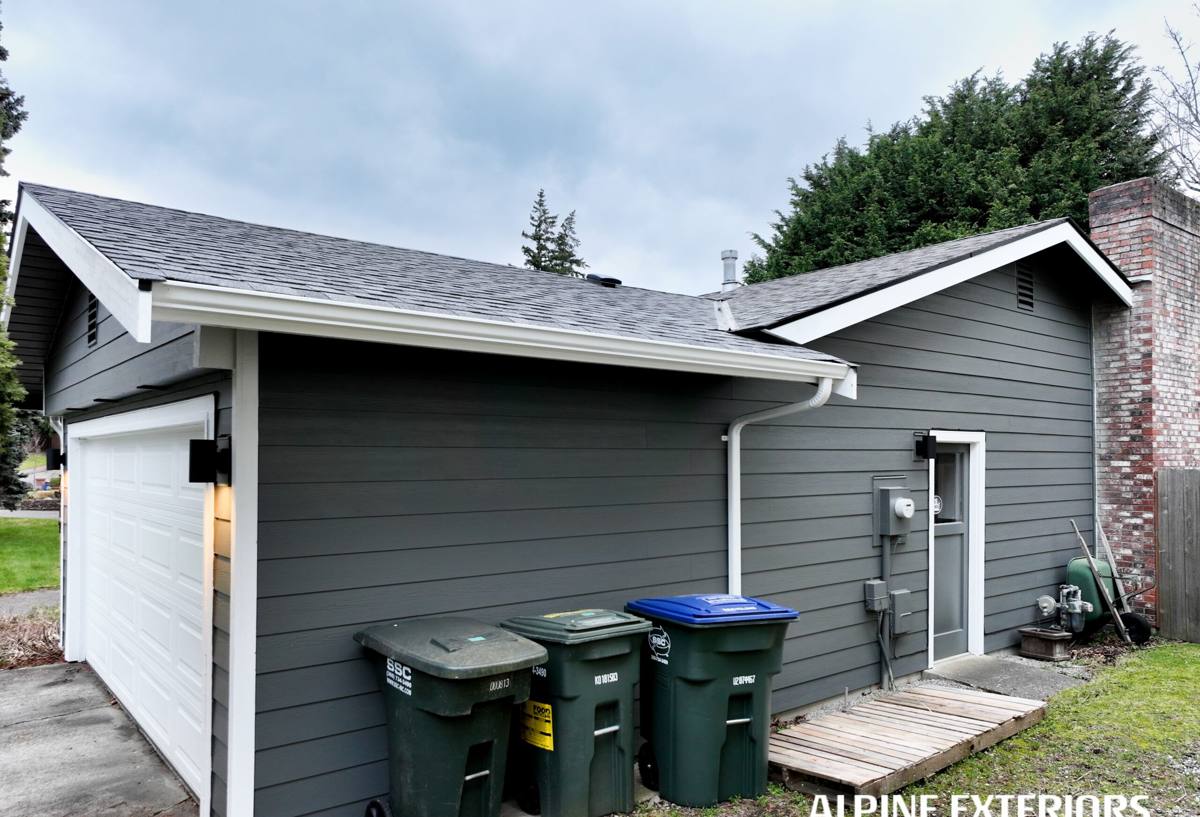
James Hardie fiber cement is non-combustible, dimensionally stable, and doesn't feed moisture the way wood-based products can. The ColorPlus factory finish is baked on under controlled conditions rather than applied on-site, which gives it better long-term color retention and adhesion than field-applied paint — a real advantage against salt air, which is hard on painted finishes. Hardie's HZ5 product line is engineered specifically for climates with more moisture exposure, and the warranty is transferable if you sell the home.
| Material | Moisture resistance | Maintenance | Typical lifespan |
|---|---|---|---|
| James Hardie fiber cement | High — non-combustible, doesn't absorb and swell like wood | Low — factory finish, occasional wash | 30-50+ years installed to spec |
| Vinyl siding | Moderate — seams and panels can allow water behind cladding | Low, but can crack or warp over time | 20-30 years |
| LP SmartSide / engineered wood | Moderate — vulnerable if moisture reaches the core | Moderate — finish and edge sealing upkeep | 20-30 years with maintenance |
| Cedar / primed spruce | Low without consistent upkeep | High — regular repainting and sealing | 15-25 years, shorter if neglected |
What Working in Geneva Specifically Changes
A siding crew that has worked homes in and around Geneva and Sudden Valley knows the patterns before they show up on a ladder. They know which elevations of a house typically take the brunt of driving rain given the local terrain and tree cover, where moss tends to establish first, and how salt-influenced air near the water changes the way fasteners and trim age compared to homes further inland in Whatcom County.
That familiarity shows up in small decisions that add up: which side of a house gets extra flashing attention, how much clearance to leave at grade given local drainage, and which details are worth spending a little more time on because they're the ones that fail first in this specific setting. A crew seeing your house for the first time and guessing at these things isn't the same as a crew that's already solved them on the house down the road.
What Drives the Cost of a Siding Replacement
Every home is different, but the same factors move the price up or down on nearly every job. Understanding them helps you evaluate a quote instead of just comparing a bottom-line number.
| Factor | Why it matters |
|---|---|
| Home size and number of stories | More surface area and taller walls mean more material, labor, and staging/scaffolding time |
| Extent of sheathing damage found at tear-off | Rot repair is discovered mid-project and can't be accurately priced sight-unseen |
| Siding profile and trim complexity | Lap siding with heavy trim, shakes, or board-and-batten accents takes more labor than plain lap alone |
| Number of windows, doors, and penetrations | Each one needs flashing and careful cutting, which adds time regardless of house size |
| Access and site conditions | Steep lots, limited driveway access, or dense landscaping can add setup and staging time |
Getting Ready for a Replacement: A Homeowner Checklist
- Walk the exterior and note any soft spots, staining, or areas with persistent moss before your estimate
- Check attic and crawlspace areas for signs of moisture that might trace back to the exterior walls
- Ask any contractor you're considering whether they inspect and replace sheathing as part of the job, not as a change-order surprise
- Confirm what weather-resistive barrier and flashing details are included — this is where quality separates from price alone
- Ask what happens to landscaping, gutters, and downspouts during tear-off and reinstall
- Get the manufacturer's specific product line and color in writing, not just "Hardie siding"
- Understand what's covered by workmanship warranty versus manufacturer warranty, and for how long
Why the Right Crew Matters More Than the Right Product
Even the best siding fails early if it's installed wrong — too little clearance at the bottom, missed flashing at a window head, fasteners driven at the wrong spacing. In a climate that pushes rain sideways and grows moss in the shade for half the year, installation quality is the difference between siding that quietly does its job for decades and siding that needs attention again in five years. That's the real reason to look past the brand name on a quote and ask how the job will actually be done.
If your home in Geneva or elsewhere around Sudden Valley is due for new siding, we're happy to take a look and give you a straightforward, no-pressure estimate — what we'd recommend, why, and what it would cost. There's no obligation, just a clear look at where your home actually stands.