 Sudden Valley Siding
 New-Construction Windows Built for South Hill's Weather
"New-construction" windows are a specific category, not just a fancy name for a new window. They have a nailing fin (also called a flange) around the perimeter of the frame, and they get installed during framing — before the housewrap goes on, or integrated directly into it — rather than dropped into an existing, finished opening the way a replacement or insert window is. That distinction matters everywhere, but it matters more in South Hill, where a wet, wooded piece of Sudden Valley meets the long, damp stretches that define a Whatcom County fall and winter.
This page is about that specific job: new builds, additions, and full wall-opening projects in South Hill where the old siding and sheathing come off (or were never there) and the window gets set into a rough opening with full access to the wall's water-resistive barrier. If you're comparing this to a simple insert-style window swap, the two jobs share almost nothing beyond the glass and frame — the flashing work is the real difference, and it's the part that decides whether the window performs for twenty years or starts leaking in five.
Why the Sudden Valley Climate Changes the Job
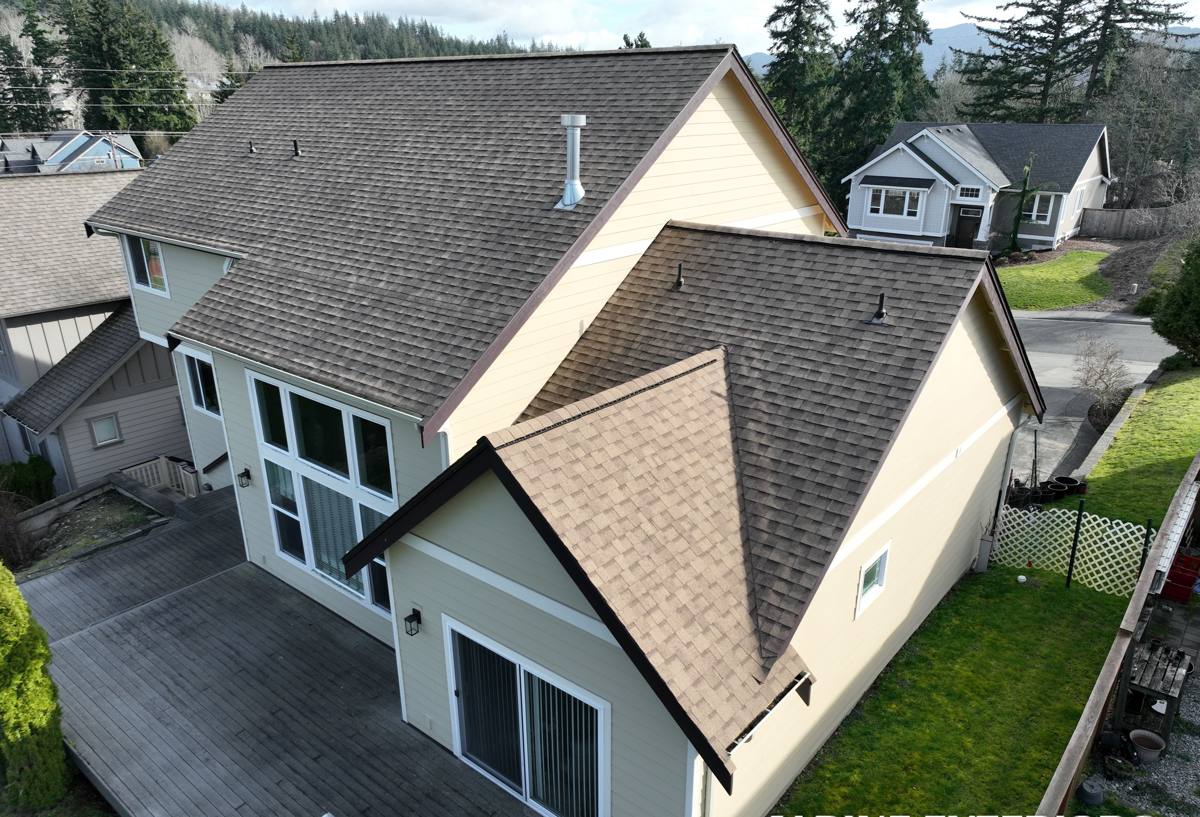
Salt air, driving rain, and a long moss season all take their toll on homes around Lake Whatcom, and South Hill's tree cover makes it worse in specific ways. Wooded lots hold shade and moisture longer after a storm passes, which is exactly the condition moss needs to establish on roofs, trim, and north-facing siding. That same lingering dampness works on window openings too — not the glass, but the wood sheathing, sill framing, and fasteners around it if the flashing details aren't right.
Driving rain in this part of Washington doesn't fall straight down. Wind pushes it sideways into wall assemblies, and a window opening is the single biggest interruption in a wall's drainage plane. Every seam, lap, and fastener around that opening is a chance for water to get behind the cladding instead of running down and off it. Add salt-influenced air moving through the region and you get accelerated corrosion on any fastener, flashing, or hardware that isn't rated for it. None of this is unique to South Hill, but it's more constant here than in drier parts of the state, which is why we treat flashing detail as the actual product being installed — the window itself is almost secondary.
What a Correct New-Construction Window Installation Involves
Sill Pan and Sloped Sills
Every rough opening should get a sill pan before the window ever goes in — either a rigid pan or a fully adhered flexible flashing membrane, formed with a back dam at the interior edge and a slight slope to the exterior. The back dam stops any water that gets past the window from running inward onto the subfloor or wall cavity; the slope makes sure that water finds its way back outside instead of pooling under the frame. Skipping the sill pan and relying on caulk alone is the single most common shortcut we see causing slow, hidden rot years later.
Shingle-Lap Flashing Sequence
Flashing has to be layered like shingles on a roof — each piece overlapping the one below it — so water is always shed downward and outward, never trapped or funneled inward. The correct order is sill pan first, then the window unit set into it, then side (jamb) flashing tape over the nailing fin, then head flashing last, with the housewrap's upper flap lapped back down over the head flashing. Get that sequence backward at any point — head flashing under the housewrap instead of over it, for example — and you've built a funnel instead of a drain.
Fastening, Shimming, and Air-Sealing
The window has to be set plumb, level, and square using shims at the right load points, then fastened with corrosion-resistant screws or nails at the spacing the manufacturer specifies — not just a staple gun run around the nailing fin. On the interior side, the gap between the rough opening and the frame gets air-sealed with backer rod and low-expansion foam or sealant, which manages energy loss and condensation. That interior seal is separate from the exterior drainage plane, and it's a mistake to treat exterior caulk as the only air or water barrier — the window needs both a drainage path outside and an air seal inside, doing two different jobs.
Choosing the Right Window for a Wet, Wooded Site
Frame material matters more here than in a dry climate, because the material spends more of the year damp, shaded, and exposed to wind-driven rain. Glass performance matters too, but in a heating-dominated marine climate like Whatcom County, a low U-factor (how much heat escapes) generally matters more day-to-day than a low solar heat gain coefficient, since sunshine is the thing South Hill homes get less of, not more. We also look at each window's AAMA/NFRC water penetration resistance rating — a higher-rated window has been tested to resist a wind-driven-rain simulation, which is a closer match to real Sudden Valley weather than a still-air lab test.
| Frame Material | How It Holds Up to Rain & Moss-Season Damp | Maintenance | Best Fit |
|---|---|---|---|
| Vinyl | Won't rot or corrode; performs well if welded corners and reinforced frames are used | Low — occasional cleaning | Most South Hill homes on a value-conscious budget |
| Fiberglass | Very stable in wet, temperature-swinging conditions; strong resistance to warping | Low | Larger openings or homes wanting a thinner sightline |
| Wood-clad | Good if cladding and flashing are perfect; exposed wood joints are a maintenance risk in a long wet season | Higher — finish and joint checks needed | Homeowners prioritizing an interior wood look who accept the upkeep |
| Aluminum | Strong but conducts cold and can corrode faster near salt-influenced air without a quality finish | Moderate | Specific architectural or commercial-style applications |
None of these are wrong choices on their own — the failure point is almost always installation, not material. But we'll tell you honestly if a given product is a poor match for a shaded, damp South Hill lot rather than sell whatever's easiest to install.
Our Process for New-Construction Windows in South Hill
- Site visit to review rough openings, framing tolerances, and the home's orientation to prevailing wind and rain.
- Coordination with your builder or framer on schedule, so windows go in at the right point relative to the housewrap and sheathing — not before the wall is ready, not so late it holds up siding.
- Sill pan flashing installed at every opening, sloped and backed, before the window is set.
- Window set plumb, level, and square, shimmed at load points, and fastened per manufacturer spec.
- Jamb and head flashing installed in proper shingle-lap sequence, tied into the housewrap.
- Interior air-sealing with backer rod and low-expansion foam, keeping the exterior drainage path clear and independent of the interior air seal.
- Final walkthrough with photos of the flashing layers before they're covered by siding — because once the cladding goes on, that's the one chance to verify the work underneath.
New Construction vs. Retrofit: Why We Don't Treat Them the Same
A retrofit or insert window drops into an existing, already-clad opening, and by necessity leans on sealant and the existing frame for water management — there's no access to rebuild a sill pan or re-flash the rough opening without removing surrounding siding. A new-construction window gives full access to the rough opening and the wall's drainage plane, which is a real opportunity, not just a formality. Our standard is that we build the full flashing assembly every time we have that access — we don't install a new-construction window as though it were an insert just because it would be faster. That shortcut saves an hour on installation day and costs a homeowner a repair years later.
Why a Crew That Already Works South Hill Matters
Sudden Valley is a covenant community with its own architectural review process layered on top of standard Whatcom County permitting, and window replacements or new openings can be subject to both. A crew that already works South Hill jobs knows what that review typically expects, has a working relationship with local builders on the same streets, and has seen how individual lots — sloped, tree-covered, oriented toward or away from the prevailing wind off the lake — actually behave in a storm. That's the kind of knowledge that doesn't show up in a spec sheet: which elevations take the worst of the driving rain, which lots hold moss and moisture longest into spring, and where extra flashing attention pays off versus where it's overkill.
Living With New Windows Through Moss Season
A correctly installed window is low-maintenance, but "low" isn't "none," especially on a shaded South Hill lot. A short seasonal check goes a long way toward protecting the installation:
- Walk the exterior once a year and look for cracked, peeling, or gapped sealant at the window perimeter — flag it early rather than waiting for a stain to show up inside.
- Keep gutters and downspouts directing water away from window heads, not sheeting down the wall past them.
- Clear moss and organic debris off sills, trim, and nearby siding — it holds moisture against the surface far longer than bare material would.
- Avoid pressure-washing directly into flashing lines or weep holes; it can force water past a system designed to shed it, not resist it.
- Make sure weep holes at the base of the frame stay open — paint and caulk applied by a well-meaning painter can seal them shut by accident.
- Watch for condensation patterns that seem new or excessive — it's often the first visible sign of an air-sealing or ventilation issue worth a look.
- Keep nearby landscaping trimmed back enough that air can move and dry the wall surface between storms.
Common Mistakes We Watch For
Most window failures we're called out to inspect trace back to a handful of repeatable errors, and part of our job on any South Hill project is making sure none of them are present:
- Flashing tape lapped in the wrong direction, so water is funneled behind the housewrap instead of over it.
- Exterior caulk used as the sole water-management strategy, with no sill pan or shingle-lap flashing underneath.
- A sill pan with no back dam, letting water run inward instead of back out.
- Fasteners driven at the wrong spacing, angle, or depth, distorting the frame or leaving gaps at the fin.
- Spray foam used as the only barrier at the rough opening, with no distinction between the air-seal layer and the water-drainage layer.
- Siding installed tight against window trim with no reveal or expansion gap, trapping moisture at the joint.
If you're planning a new build, an addition, or a full-opening remodel in South Hill and want windows installed the way this climate actually requires, we're glad to walk the site with you. Reach out for a free, no-pressure estimate — the form below gets you started.