 Sudden Valley Siding
 Storm Damage Roof Repair for Acme Homes
Acme sits in the kind of Whatcom County terrain that takes weather seriously — timbered hillsides, damp valley air, and winter storms that roll in off the Pacific with real wind behind them. A roof out here doesn't just get rained on, it gets soaked, dried, soaked again, and shaded by trees for months at a stretch. That cycle is what actually damages roofs, more than any single storm event. When a windstorm finally does lift a run of shingles or a branch comes down on a slope, it's usually finishing off wear that's been building for years.
We're based nearby in Sudden Valley and have worked on homes throughout this part of the county long enough to know what that combination of driving rain, salt-tinged coastal air, and a moss season that can run eight months or more actually does to a roof over time. This page covers what storm damage repair should look like for a home in Acme specifically — not a generic patch job, but a repair that accounts for the climate it has to survive.
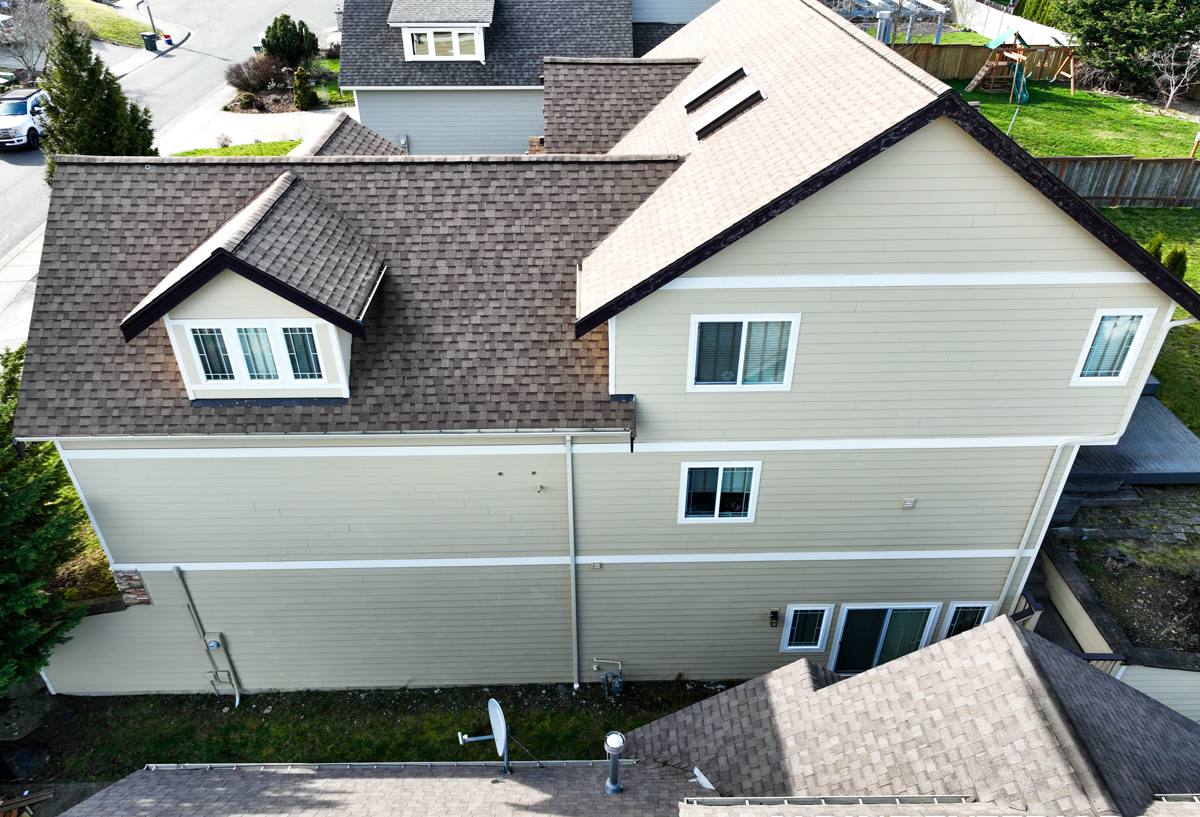
What Whatcom County Weather Does to a Roof
Driving Rain and Wind-Driven Water
Storms here rarely come straight down. Wind pushes rain sideways and uphill under shingle tabs, around flashing, and into any gap that a calm-weather rain would never reach. A roof that looks fine from the ground can have water tracking sideways under the felt or membrane at every edge, valley, and penetration. This is why storm damage repair has to look past the obvious torn or missing shingle and check the water paths around it.
Moss and Prolonged Moisture
Shaded, damp roof sections in and around Acme grow moss on a timeline most drier climates never deal with. Moss holds water against the roofing material long after a storm has passed, works its way under shingle edges as it grows, and lifts tabs enough for wind to finish the job. A roof with heavy moss coverage is already weakened before the next storm ever arrives — which is why moss condition matters as much as visible storm damage when we're scoping a repair.
Salt Air and Metal Fatigue
Whatcom County's proximity to the Salish Sea means homes here deal with a mild but steady salt content in the air, which accelerates corrosion on exposed metal — flashing, fasteners, gutters, and any exposed roofing hardware. Corroded flashing is one of the most common hidden causes of a leak that only shows up during a storm, because the metal fails quietly for years before it actually lets water through.
Common Storm Damage We See in Acme
- Wind-lifted or missing shingles, usually along ridges, edges, and any slope exposed to prevailing wind
- Cracked or displaced ridge caps from sustained gusts
- Impact damage from limbs and debris, common on tree-lined lots
- Flashing separation around chimneys, skylights, and vent penetrations after repeated freeze-thaw and wind cycles
- Granule loss on older asphalt shingles, accelerated by years of driving rain
- Moss-related lifting that turns a minor storm into an active leak because the shingle was already compromised
- Gutter and downspout damage that redirects water back up under the roof edge instead of away from the house
What a Correct Storm Damage Repair Actually Involves
A repair that only replaces the shingles you can see from the ground is a repair that will likely need doing again. Storm damage almost always affects more than the visible surface, and a repair done right addresses all of it in one visit rather than leaving the underlying causes for the next storm to expose.
Full Slope Inspection, Not Just the Damaged Spot
We check the entire affected slope, not just the obvious tear or gap, because wind damage tends to loosen fasteners and lift adjacent shingles that haven't fully separated yet. Missing that now means a second service call after the next storm.
Underlayment and Decking Check
If water has been getting under the roofing material — which is common with wind-driven rain — the underlayment and, in some cases, the deck sheathing underneath it can be compromised. A shingle-only repair over damaged decking is a repair that fails again, often worse the second time.
Flashing and Penetration Detail Work
Given how much of the leaks we find trace back to flashing, we inspect and, where needed, replace flashing at chimneys, vents, skylights, and valleys as part of the repair rather than treating it as a separate issue. This is the detail work that determines whether a repair actually holds through the next storm season.
Moss and Debris Clearing
Where moss or accumulated debris contributed to the damage, we clear it as part of the job and talk through what ongoing moss control would mean for that specific roof. Leaving moss in place around a fresh repair just sets up the same failure again.
Our Process, Step by Step
- Inspection and documentation. We walk the roof (or use safe alternative methods where pitch or access requires it) and document the damage, its likely cause, and its extent.
- Honest scope discussion. We tell you what actually needs repair versus what's cosmetic or can reasonably wait, and explain why.
- Written estimate. Clear scope, materials, and price before any work starts — no verbal-only agreements.
- Repair work. Matching materials where possible, correcting the underlying cause (flashing, decking, ventilation) rather than just covering the symptom.
- Final walkthrough. We show you what was done and what to watch for going forward.
Repair vs. Replacement: What Actually Drives the Decision
Not every storm-damaged roof needs full replacement, and not every roof that looks rough from the driveway is actually a repair candidate. The honest answer depends on a handful of factors we walk through with every homeowner before recommending either direction.
| Factor | Favors Repair | Favors Replacement |
|---|---|---|
| Roof age | Under roughly 12-15 years, otherwise healthy | Nearing or past its material's expected service life |
| Extent of damage | Isolated to one slope or a limited area | Spread across multiple slopes or recurring in the same spots |
| Decking condition | Sound, dry sheathing under the damaged area | Soft, delaminated, or water-stained decking found on inspection |
| Moss/moisture history | Manageable with cleaning and ventilation fixes | Long-term moss damage affecting large sections |
| Shingle match availability | Reasonably close match still available | Discontinued material with a visible mismatch |
| Insurance scope | Adjuster approves targeted repair | Adjuster or inspection supports full slope or full roof |
We don't push replacement when a repair will genuinely hold, and we won't recommend a patch when the decking or underlayment tells us it's not the honest fix. That call gets made from what we actually find on your roof, not from a standard script.
Materials and Technique Choices for This Climate
Given how much moisture and moss this area deals with, we pay particular attention to a few things on every storm repair: ventilation (poor attic ventilation traps moisture and accelerates deck rot from underneath), fastener and flashing material (corrosion-resistant hardware matters more here than in drier inland climates), and underlayment quality (a synthetic or high-quality felt underlayment gives real backup protection against the wind-driven rain this area sees). These aren't upsells — they're the standard we hold repairs to because a repair that ignores them tends to need revisiting within a few storm seasons.
Insurance Claims: What to Know Going In
Many storm damage repairs in Acme are at least partially insurance claims. We can document damage clearly enough to support a claim, but we're not adjusters and won't promise a coverage outcome we don't control. What we can do is give you an honest, itemized scope so you're not guessing whether an adjuster's assessment matches what the roof actually needs. If a claim gets denied or under-scoped, we'll walk you through what we found so you can decide how to proceed.
Why a Crew That Already Works Acme and Sudden Valley Matters
Storm damage repair has a time-sensitivity problem: the longer a compromised roof sits, the more water gets in and the more the repair scope grows. A crew already working this part of Whatcom County can generally respond faster after a storm than one traveling in from outside the area, and having handled other roofs in similar terrain and tree cover means we're not guessing at how local conditions have already aged the roof in front of us. We also know which failure points show up again and again on homes around here — flashing corrosion, moss-lifted edges, wind-exposed ridge lines — and we check those specifically instead of treating every roof as a blank slate.
Signs You Should Get a Roof Checked After a Storm
- Granules collecting in gutters or at downspout outlets
- Daylight visible through the attic roof deck
- Water stains on interior ceilings or upper walls
- Shingles that look curled, cracked, or missing from the ground
- Sagging or soft-feeling sections when viewed up close
- Debris or limb strikes on any slope
- Heavy moss growth combined with any of the above
Getting Storm Damage Repaired Right the First Time
The cheapest storm repair up front is rarely the cheapest one over five years, especially in a climate that gives a roof no real off-season to dry out and recover. A repair that addresses the actual cause — not just the visible damage — is what keeps a storm-damaged roof from becoming a recurring problem every time the wind picks up.
If you've got storm damage on a roof in Acme, or you're not sure whether what you're seeing is storm damage or just the normal wear this climate causes, we're happy to take a look. Reach out for a free, no-pressure estimate using the form below, and we'll give you a straight answer about what your roof actually needs.