 Sudden Valley Siding
 Composite Decking Built for the Way Barkley Actually Weathers
Homes around Sudden Valley and the Barkley area sit in one of the wetter, mossier pockets of Whatcom County. Lake Whatcom's humidity, the marine air drifting in off the Sound, and a rainy season that can run eight or nine months a year all work against a deck the same way they work against roofs and siding. Composite decking earns its keep here, but only when it's specified and installed with that climate in mind — not just laid down like it would be in a drier part of the state.
This page covers what a composite deck needs to hold up in Barkley specifically: the moisture and moss pressure it's up against, what a correct installation actually involves, how our process runs from first look to final walkthrough, and why hiring a crew that already works this neighborhood saves you from problems that show up two or three winters in.
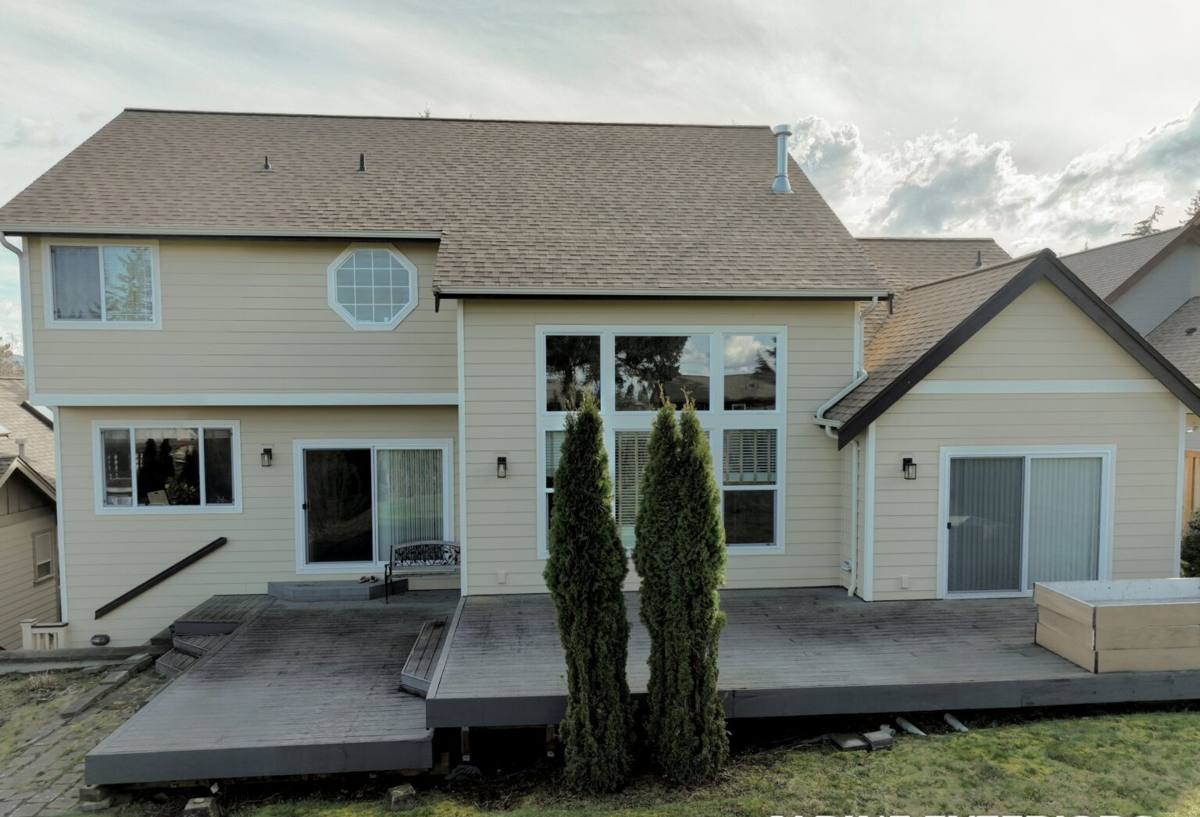
What Barkley's Climate Actually Does to a Deck
It helps to be specific about the stresses at play, because they're not the same stresses a deck faces in eastern Washington or even in drier parts of the Puget Sound region.
Driving Rain and Standing Moisture
Wind-driven rain off the lake and the Sound doesn't just fall straight down — it gets pushed sideways into ledger boards, railing posts, and the gaps between deck boards. Any spot where water can collect instead of shedding becomes a slow-motion problem: swelling in the substructure, staining, and eventually rot in whatever wood framing is underneath the composite surface.
Salt Air and Metal Fasteners
Proximity to the Sound means a light but steady dose of salt in the air, which accelerates corrosion in the wrong grade of screws, brackets, and joist hangers. A deck can look fine on the surface for years while its fasteners quietly corrode underneath.
A Long Moss and Algae Season
Whatcom County's moss season isn't a few weeks — on shaded, lake-adjacent lots it's most of the year. Composite decking resists rot the way wood can't, but it isn't immune to surface algae and moss buildup, especially on boards that stay damp under tree cover or on the north side of a house. Ventilation underneath the deck and drainage between boards matter as much as the decking material itself.
Capped Composite vs. Older Wood-Plastic Composite
"Composite decking" covers a range of products, and the differences matter more in a wet climate than in a dry one.
- Capped composite has a polymer shell wrapped around a wood-fiber and plastic core, which keeps moisture from soaking into the board itself. This is what we recommend for Barkley's exposure.
- Uncapped or older-generation composite is more porous. In a climate this wet, it's more prone to moisture absorption, surface mold, and fading over time.
- Solid PVC decking is fully synthetic with no wood fiber at all, which handles moisture even better but comes at a higher price point and a different look and feel underfoot.
We'll walk you through the real trade-offs for your project rather than pushing one product line — the right call depends on your budget, how shaded the site is, and how the deck will be used.
What a Correct Composite Deck Installation Involves
The decking boards themselves get most of the attention, but in this climate the parts you don't see are what determine whether the deck lasts fifteen years or thirty.
Ledger Board Flashing
Where the deck attaches to the house is the single most common failure point on any deck in a rainy climate. Correct flashing — metal flashing integrated with the house's water-resistive barrier, not just caulk over a ledger board — keeps water from tracking behind your siding and rotting the rim joist.
Joist Protection Tape
Every cut and every top surface of a wood joist should be covered with a self-adhering flashing tape before the composite boards go down. This is a small material cost that prevents the framing underneath a perfectly good composite deck from rotting out from underneath it — a failure that's invisible until the deck starts to feel soft.
Board Spacing and Drainage
Composite boards need consistent gapping to let water drain through rather than pool on the surface. Too tight, and the deck holds water and grows algae faster; too wide, and it looks sloppy and catches debris. This is a detail that's easy to get wrong when a crew is moving fast.
Fastening
Hidden fastener systems keep the surface clean and reduce the number of penetration points where water can get into a board, but they need to be rated for the specific board profile and installed at the right spacing. Face-screwed boards, if used at all, need corrosion-resistant fasteners given the salt air in this area.
Substructure and Footings
Post footings need to be sized and set below frost depth per local building code, with proper drainage around them so they're not sitting in saturated soil all winter. On sloped Barkley lots, this often means more engineering thought than a flat-yard deck would need.
Composite vs. Wood Decking for This Climate
| Factor | Capped Composite | Cedar | Pressure-Treated Wood |
|---|---|---|---|
| Moisture resistance | High — sealed shell resists absorption | Moderate — needs regular sealing | Moderate — treatment slows but doesn't stop rot |
| Moss/algae resistance | Good with proper drainage; still needs occasional cleaning | Prone to graying and moss without upkeep | Prone to moss, especially in shade |
| Maintenance | Periodic washing; no staining or sealing | Annual or biannual staining/sealing | Annual staining/sealing to prevent splitting and rot |
| Upfront cost | Higher material cost | Moderate | Lowest |
| Long-term cost | Lower over 20+ years given low upkeep | Higher due to ongoing sealing labor | Higher due to ongoing sealing and earlier replacement |
| Typical lifespan here | 25–30+ years with correct installation | 15–20 years with consistent maintenance | 15–20 years with consistent maintenance |
None of these numbers are guarantees — they depend heavily on how shaded the site is, how much sun and rain exposure the deck gets, and whether the installation details above were handled correctly. A composite deck installed without proper flashing and drainage can fail faster than a well-maintained wood deck.
Our Process for a Barkley Composite Deck
- On-site assessment. We look at drainage, shade, existing structure (if replacing an old deck), and how the deck ties into your siding and roofline.
- Material and layout plan. We talk through board type, color, railing options, and layout — including board direction, which affects both drainage and appearance.
- Permitting. Most new decks and many deck replacements in this area require a permit through the applicable local building department. We handle that process rather than leaving it to you.
- Demolition and framing. Old decking comes off, framing is inspected and repaired or replaced as needed, and footings are set or verified.
- Flashing and joist protection. Ledger flashing and joist tape go in before a single composite board is installed — this step doesn't get skipped to save time.
- Decking, railing, and fastening. Boards go down with correct spacing and fastening for the product and climate.
- Final walkthrough. We go over the finished deck with you, including what maintenance it actually needs (usually very little) and what to watch for.
Why a Crew That Already Works Barkley Matters
A composite deck built to a generic spec sheet, without accounting for a lake-adjacent, high-moss microclimate, is where problems start. A crew that regularly works Sudden Valley and the surrounding Whatcom County neighborhoods already knows which lots hold moisture longest, where salt air corrosion shows up first, and how local building department requirements apply to decks specifically — not just siding or roofing. That local pattern recognition is the difference between a deck that needs attention in year three and one that doesn't need much of anything for two decades.
Maintenance a Composite Deck Actually Needs Here
- Rinse or lightly scrub the surface once or twice a year to remove pollen, moss spores, and organic debris before they take hold — more often on heavily shaded sections.
- Keep gutters and downspouts near the deck clear so runoff isn't dumping extra water onto or under the deck surface.
- Trim back overhanging branches and vegetation to cut down on shade and debris, both of which feed moss growth.
- Check railing posts and fastener points annually for any sign of movement or corrosion staining.
- Clear leaves and debris from between boards and from under the deck where airflow matters most.
- Avoid pressure-washing at high pressure directly into board seams, which can force water into places it shouldn't go.
If you're weighing composite decking for a home in the Barkley or Sudden Valley area, we're glad to walk your property, talk through what your specific site needs given its sun and shade exposure, and give you a straightforward, no-pressure estimate. There's a form below to get that started.